Showing posts with label serval. Show all posts

Wednesday, August 30, 2023

Another pet serval cat escapes this time in Halifax, Nova Scotia

Yet another pet serval cat has escaped someone's home in North America. In this instance it happened in Halifax, Nova Scotia, Canada. So, it isn't just the Americans who like to keep pet servals; sometimes Canadians do it as well but wherever they are it's a mistake.

Click this link to see a series of pages on many serval cats escapes. It is almost endemic in the US as there are too many pet servals confined to the home where the cat has one objective: to bloody well escape! It is madness and very cruel to keep a serval confined to a house.

This medium-sized wildcat, the serval, does not make a good pet. They are too large and although they can be tamed they cannot be truly domesticated and therefore they behave like a medium-sized wildcat at a zoo but the problem is they are in your home where they might spray urine against the walls. 

And you may have to declaw the animal because when they slap your wrist or hand injure you. And declawing a serval is a very cruel operation. The whole process of pet servals is a mistake in my honest opinion.

The story today on this escaped serval is that they ended up on the streets of west-end Halifax last Sunday where a pedestrian, Rachel Smith, photographed it at the corner of Sunset Avenue and Withrod Drive having a bit of a face-off with a house cat who escaped to high ground as you can see in the photograph.

Serval escapes in Halifax, Nova Scotia
Serval escapes in Halifax, Nova Scotia. Image: Rachel Smith.

Thankfully, this particular serval was captured by animal control and animal rescue volunteers on Monday afternoon and they are taking good care of the animal. That isn't always the outcome as you might imagine. Sometimes somebody with a gun just shoots the cat because they are frightened of them.

A serval roaming around the streets of the United States in particular is in great danger because there are a lot of firearms in America and a lot of itchy fingers wanting to pull the trigger. If they see what they believed to be a wild cat in suburbia, in a public place, they might feel tempted to shoot it to protect the public without realising that the cat is tame and probably not a danger.

Or perhaps the police get called out and they shoot the cat which is the kind of thing they would do in order to protect the public!

Unsurprisingly, the serval is listed as prohibited under Nova Scotia's Wildlife Act and therefore they cannot be kept as a pet in a home. It is almost certain that in every corner of North America the server will be prohibited as a pet or you will need a licence to keep the animal as a pet. And if a licence is required you will need to have facilities to properly look after the cat and there will be regular inspections to ensure that you maintain the proper standards.

This points to the simple conclusion that servals are not really meant to be pet. It isn't people like me who say they shouldn't be pets, it is also the authorities in North America who agree with me.

It has been suggested by the author of the article that I am reading that the serval in question might have been bred in Ontario where it would be legal and then imported into Nova Scotia which is illegal.

People like to possess exotic pets. They romanticise the idea of looking after and living with an exotic animal such as the serval but reality pretty quickly clicks in and there is not much romance in in such a relationship. You have to be experienced and committed and have good knowledge plus good facilities. Keeping them in the home like a domestic cat isn't going to work. A lot of pet servals are given up to zoos or to breeders.

Rob Laidlaw, the founder of Zoocheck, said that a lot of people don't realise that they are wild animals but think of them as big house cats which they are not. And servals, he said, are known to be good escape artists. I would agree that because I have reported on numerous serval escapes. I would like to refer you to the above link if you would like to read about them.

If there is an opportunity for the serval to escape they will. This puts a lot of pressure on the owner to keep them confined. It is easy to make a mistake for a brief moment and then the serval will be out the door and away. They can run at 45-50 miles an hour!

Sunday, February 13, 2022

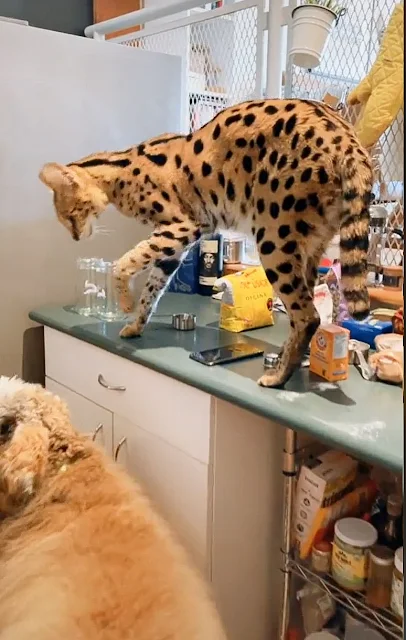
Serval on the kitchen counter smacks dog who's on the floor

This is an unusual household. The woman calls herself a 'serval whisperer' by which she means that she is a serval expert and can communicate with her cat companion. Servals are wild cats. They are lanky. In fact, they have the longest legs to overall size of all the wild cat species.

Serval on the kitchen counter smacks dog who's on the floor
Serval on the kitchen counter smacks dog who's on the floor. Screenshot.

Some people might like to see the video below and some might think that this looks just fine. I don't. I think it is entirely wrong to have a serval as a pet confined to the home which they must be. You cannot let this cat go outside alone for obvious reasons. And when they are confined to a home like this they want to escape. Some do escape and often they are killed outside by the police who shoot them because a neighbour complained that there is a wild animal roaming around the neighbourhood. Or a car hit them. The outcome is normally bad.

Note: This is a video from another website which is embedded here. Sometimes they are deleted at source which stops them working on this site. If that has happened, I apologise but I have no control over it.

The cat is obviously slightly twitchy about the presence of the dog. This is why she slaps him. This indicates a little bit of friction between the two. No surprise there. I wonder whether the serval whisperer could do something about that? The answer will be no. You can imagine what it is like to have that slightly antagonistic state of affairs.

It may result in the serval spraying urine to mark territory. Sometimes they spray urine inside the home because they might be stressed. That is not the sort of experience you want as a home owner. Sometimes serval owners declaw their servals because they want a serval i.e. an exotic pet, but they don't want to be slapped as you see in the video on their hand by their over-sized cat companion because it will hurt. It can draw blood.

You don't want to play with a serval like you would play with your domestic cat companion because they may hurt you. But, that said, they desperately need to be stimulated. There is no greater need to stimulate a cat than a serval. They are smart and active and have heightened wild cat senses. So how do you do it? I just see so many potential and actual problems with having a serval as a pet.

I have a page on keeping servals as pets which may interest anybody who wants to read more about this topic. And lastly, depending upon where you live, you may need a licence to look after a serval in your home. There will be differences between the states in America. In the UK you need a licence. In some US states you won't need the permission of the local authority to keep a serval which may be the case with this woman in the video.

Thursday, November 22, 2007

Sokoke Cat

Photographs illustrating this article are by Helmi Flick and are her copyright.

Click here to see all the breeds including an analysis of the rare breeds.

Just had a look at this very little known cat and she is probably the rarest domestic cat on the planet. The breed's history is what interested me but it is a little hazy and to my mind leaves some questions to be answered. This is a great cat with a character a little like the Bengal cat but it is the history that requires the most attention.

It is said that this breed has existed for perhaps centuries in and around the Sokoke Forest which is close to the Savanna that straddles North Tanzania to South East Kenya. There is a town called Sokoke as well.

The local people, of the area, the Giriama tribe, knew of the cat. They knew it wasn't a wild cat nor a domestic cat as her appearance was quite distinct. This cat has an elegant slightly rangy appearance with long legs. She is not dissimilar to the Savannah cat, which is a man made cross between the wild Serval and a domestic cat (and the Bengal being introduced later).

The locals called the cat, "Khadzonzo". This word means "look like tree bark", because as you can see from Helmi Flick's photographs the modified tabby pattern (marbled) against a brown background looks a bit like bark.

It is said that they ate the cat as she tasted sweet. This apparently has stopped (perhaps as a result of the intervention of Western people in exporting this cat to the Wet and making a breed of cat out if her).

Anyway, this is a cat well known to the area in Kenya and is probably a feral domestic cat on the evidence. She still inhabits the area but as far as I can gather is rarely seen.

As she looked very similar to the Savannah cat, whose genetic parents are the Serval and a domestic cat, I thought that the Sokoke could be the result of the mating of a Serval and a local domestic cat. Especially as the habitat of the Serval is the Savanna, which is close to the Sokoke forest area.

As it happened a former horse breeder, plantation owner and artist (Jeni Slater) lived near the forest. One of her servants found kittens and mother hidden in a tree. Their interesting coloring and conformation attracted her and the first steps in the founding of this breed began. The year was 1978.

Since then they cat has been exported to the West, firstly to Denmark, Italy and then the US and Canada. The breed is accepted for full registration by FiFe and the TICA has agreed registration fairly recently

There are few breeders of this lovely cat. She has a pleasant character and like a lot of "jungle type" cats likes or doesn't mind the water. Lots of cats hate it.

As far as I can ascertain there are probably no more than about 50 Sokoke in existence but this is a bit of a guess. It is certainly a very small number as there are very few breeders.

The breeder who seems to top the list is Sunbright Sokokes

From Sokoke to Serval

Wednesday, November 21, 2007

Iowa Ban Wild/Domestic Hybrid cats

AN ACT REGULATING DANGEROUS WILD ANIMALS, INCLUDING THEIR OWNERSHIP AND POSSESSION, REQUIRING REGISTRATION, PROVIDING FOR FEES AND APPROPRIATIONS, AND PROVIDING PENALTIES.

BE IT ENACTED BY THE GENERAL ASSEMBLY OF THE STATE OF IOWA

You can see an extract of this law under another article on the subject just below this one.

The photograph illustrating this article is by Helmi Flick copyright Helmi Flick

Comment: On the face of it this means a ban on Bengals including SBT Bengals (Stud Book Tradition). SBT Bengals are 4th generation, at least, and have about 12% wild blood in them. They are bred to be non-challenging and are true domestic cats, albeit it more active and more demanding than some other breeds.

This legislation which as far as I am aware is in force seems to have gone too far. Breeders have spent years developing a domesticated socialized Bengal cat. The other cats that fall into this category would be the Chausie and Savannah.

The tame wild cat would the Serval. Keepers can keep their "dangerous" cats (obviously) but need to register and pay a fee. As I understand it existing keepers will need also to microchip, supply a color photo of the cat, get insurance and keep the cat in an enclosure except under specific and authorized conditions.

Breeders can it seems seek exemption under conditions.

USDA licensed owners and breeders ARE NOT EXEMPT unless they are 501(c)3
non-profit as well, or are carrying out wildlife rehabilitation

I don't know what this means, if anything, on wider scale. Will there be a knock on effect and why are Bengals banned? What is the underlying thinking? On the face of it the purpose of the Act is the protections of the public from "dangerous" animals.

Are Bengal cats dangerous - No.

From Iowa Ban Wild/Domestic Hybrid cats to Cat Chit Chat

Friday, November 9, 2007

A wild cat as a pet


The Serval is a wild cat. A fine cat of medium size in the wild in Africa, yet a large domestic pet. There is a particular fascination with wild cats. It is the appearance first and foremost that fascinates. Then there is the athleticism that impresses us. The picture adjacent is of a Serval Cat copyright Helmi Flick.

Some people take the step from admiration to adoption (or some might consider it "ownership"). Then you enter a whole new ball game.

As Helmi so eloquently says on my website, there are added responsibilities in caring for a tame wild animal such as a Serval cat. On this page of my website she talks about living with an F1 Chausie, which is a first generation wild cat/domestic hybrid. The same concerns and more relate to living with a tame wild cat.

Observing people's fascination with wild cats, why is that the population of wild cats is dying out due to mankind's activities?

The answer must be man's arrogance in believing that he/she owns the world and can own animals and do as he pleases. Arrogance is compounded by a lack of education in some (and no criticism is intended). This is a toxic combination. One day all people (not just a percentage) will see animals differently; as equal and different.


Search This Blog