Showing posts with label veterinarian. Show all posts

Saturday, September 2, 2023

Veterinarian reveals the 4 household items that she considers the most dangerous to cats


ABOVE: This nail polish is not on the vet's list but there are many items and chemicals in the home that are potentially of actually toxic to cats. Click on the link below to see a lot of them.

RELATED: List of articles on 'toxic to cats'.

A veterinarian, Dr. Savageau has revealed what she considers to be the 4 common household items that are actually or potentially hazardous to cats. These are the preferences of this particular veterinarian. There are many other possible hazardous items in the home but I will list the four that this female veterinarian has chosen.

Tylenol

The first item is a very common drug used by humans namely Tylenol which contains paracetamol. 

We know that paracetamol is very toxic to cats and Dr. Savageau confirms this by saying that, "Tylenol is very toxic to cats and can kill them quickly even if they just lick it will bite into a gel capsule."

Antifreeze

Antifreeze is perhaps the most common cat poison because it is used extensively by cat haters and nasty people who want to kill cats who are out and about on the street and in back gardens. 

People put down antifreeze to kill cats. Yes, they do that and antifreeze destroys kidney function which leads to kidney failure and inevitably death.

Strings and ribbons

The veterinarian says that the third item on her list is strings, ribbons, sewing needles and thread. These are particularly hazardous because cats like to mess around with them and investigate and sometimes ingest them which means that they have a nasty foreign body inside their throat, stomach or intestines where they can form an obstruction or the gastrointestinal tract is pierced by the foreign object.

Dog flea treatments

In the fourth item that Dr. Savageau would list in the top four common toxic items that she deals with as a veterinarian would be flea medications or flea treatments for dogs being used on cats. Dr. Savageau said that "Flea medications that are for dogs only are very toxic to cats."

I'm sure that there are many instances of people living with cats and dogs using the same flea treatment for their cat and dog which simply must not happen ever. 

And neither can cat food be given to dogs and dog food be given to cats. They both have a particular requirement for a particular diet and nutrients in food. For a short period, you can feed one species the other species' food but only for a short period. Do it for a long time and there will be health problems.

Saturday, August 19, 2023

How to choose a veterinarian for your cat!

Ideally, you should take your new pet for a complete veterinary checkup within 48 hours of bringing him/her home. This must be good advice but it depends upon the history of how you acquired your cat. They may well have had a checkup before you adopted him or her. And you may already have chosen your veterinarian, but if not, how do you go about finding the right one?

Choose your vet sensibly and carefully if you can
Choose your vet sensibly and carefully if you can. This images in the public domain.

You may simply go to the nearest one but that might not be the best method. Many veterinarians in the UK, for instance, have now been bought up by big conglomerates and therefore they have lost that individuality that you receive from independent veterinarians. It's a setback in terms of animal welfare in my opinion. 

Independent veterinarian

Personally, if you can find an independent veterinarian local to you, I would select them as a priority provided that they check out as per some suggestions below. They are likely to give you a better service because they have a vested interest, personally, in providing an excellent service because they run their own business. In a chain of veterinarian clinics, the overall management is conducted by administrators remotely.

In America, the American Animal Hospital Association can give you the names of qualified veterinarians in your area. Other sources in America would be the local veterinary association or Humane Society. Don't just ask for names; be specific with your questions about these animal doctors and their specialities.

Specially qualified to deal with cats

Remember, that some veterinarians are specially qualified in dealing with cats. This might prove to be important in achieving the best outcome. You might enquire about that. In the UK, there is The International Society for Feline Medicine. These veterinarians should be better at diagnosing and treating feline health problems. If you can find one local to you so much the better. America has similar associations of feline specialists.

Emergencies

Find out whether the veterinarian recommended to you works in an animal hospital near your house, in case there is an emergency. Does he or she make house calls? Is it possible to obtain emergency care after hours, or on weekends and holidays?

See the facility

Before selecting a veterinarian, meet with the doctor and ask to be shown around the facility. Is the facility bright, clean and pleasant smelling? If not, you do not want your new cat treated there!

If the veterinarian you are interested in does not take the time to answer all your questions and address your concerns, or if you detect a reluctance to allow you to tour the hospital, he or she is not the professional to whom you should entrust the care of your cat. That sounds like tough advice but it comes from a veterinarian! 

Standards and experience

You will find quite a range in standards among veterinarians. Don't presume that all veterinarians are the same and all are highly trained and very experienced because they are not all the same. And ideally, I would suggest that a veterinarian with at least 10 years' experience is going to be better than a newly qualified veterinarian. Perhaps that is common sense.

RELATED: Alabama veterinarian grossly abuses elderly cat while being filmed.

Bring a stool

When you bring your cat in for his first examination, bring along any vaccination or health records from the place you bought or adopted him. Also bring a fresh stool sample with you in a plastic bag so that your veterinarian can check for signs of internal parasites.

Checkups

A kitten should have his first checkup when he is about six or eight weeks old. The veterinarian will take the cat's history and give him a general examination. The kitten will also receive the first in a series of vaccinations to guard him against several serious illnesses.

Even if your new cat seems perfectly healthy, he should receive an examination along with the necessary vaccinations. Animal examinations and booster shots should follow. Whenever you take your cat for his yearly exam, remember to bring along a fresh stool sample.

Wednesday, August 16, 2023

Keep threads of all kinds fully inaccessible to cats inside the home

This is a story, ultimately, about keeping your home tidy! I don't mean overly tidy but I do mean keeping stuff off the floor particularly threads of cotton or string which your cat might find attractive to chew and swallow. Domestic as do have a habit of eating stuff on the floor. It might be a dead fly or a bit of the fur that you have combed off your cat and it might just as well be some thread which for some reason or other ended up on the floor and you missed it.

The story tells me that cat owners simply must make sure that there are no threads lying around the floor in the home if you've got a cat or cats. Or make sure threads are inaccessible if they are somewhere else.

Orlando who ate a long thread that causes serious problems for cat and owner alike
Orlando who ate a long thread that causes serious problems for cat and owner alike. Image: Orlando's owners.

Orlando

In this story, a cat called Orlando (a quirky soul) living with a woman and her female partner in a multi-cat home in Sussex, UK managed somehow to ingest a very long black thread. Orlando's owners don't know how she got it or where it came from but it must have been inside their home. We don't know what their home looks like so I can't comment.

But once Orlando had eaten the thread everything went downhill from that point. Another unfortunate aspect of the story is that after Orlando became ill and stopped eating, they took her to the local veterinarian who gave her anti-sickness pill because she was being sick. The vet then sent her home. That obviously didn't fix the problem. Is that an example of poor veterinary service? 

Test for foreign body?

Clearly the lesson there is that vets should by default check for foreign bodies which means doing some tests I am afraid. The tests would have been covered by the owners' pet health insurance policy.

The owners then took Orlando to another vet who did some blood tests. Neither veterinarian could see the thread that had gone right down into her intestines and perforated them in two places.

Orlando remained ill and was kept in by the second veterinary clinic who wisely did an ultrasound diagnosis and discovered the thread inside her body.

Read the insurance policy in full!

The next problem was this: Orlando's owners had a pet health insurance policy but it had a maximum expenditure of £4,000 a year. The operation to remove the thread, which in itself was life-threatening, and ancilliary care cost £7,000.

So, the owners are £3000 out of pocket. What did they do? They went online and set up a crowdfunding page to ask the public to give them £3000. I find that unacceptable myself. Begging the public for help when, on the face of it, the problem was careless cat ownership.

And if you can't afford to look after your cat properly then don't have cats. I am being tough but I don't think it is right to go to the public to help you pay for your cat's health expenses.

Orlando is recovering. As expected, as soon as the thread was removed, she started to improve although there was a short phase afterwards when she had a fever with a 40°C temperature and remained ill until the fever subsided.

One of the cat's owners is disabled and is cared for by her wife. They say that a lot of lovely people have donated to the fund and the veterinary clinic couldn't have been better.

Check the home for potential 'foreign bodies'

In this article I have focused upon the problem that caused all these other problem which is that a long thread was left somewhere within the house in a place where it was accessible to one of their cat namely Orlando. That's the error and it's a minor error I guess but it is one which caused major problems. 

Every cat owner should go around the house and make sure that it is tidied up and that there are no threads of any shape, size or length within the home they can be accessed by a cat or cats.

The story is also a lesson about pet health insurance. The owners didn't know that their insurance policy had a £4000 limit. Nobody wants to read these horrible policy documents but you have to if you pay monthly insurance premiums which are not cheap because what's the point of having one if it doesn't cover the cost?

Sunday, October 30, 2022

Is Ben the Vet right about the four cat breeds he would never own?

Ben the Vet is a UK veterinarian with a healthy social media presence. He can speak to his followers and it gets picked up on the news media. It's always interesting to hear the views of a veterinarian. They can have a slightly different perspective on companion animals because they interact with them in their clinic's consulting rooms.

They see a different aspect of animal behaviour and of course they are tuned into the health of these animals including inherited diseases. Ben criticises: Bengal cats, Sphynx cats, Scottish Fold cats and Persian cats.

He's picked out four purebred cat breeds but, to be perfectly honest, he could have picked out more. But is he right to be critical of these four cat breeds?
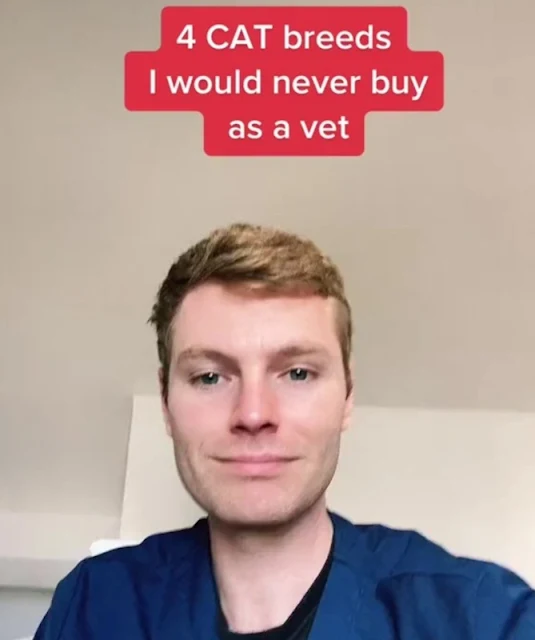
Ben the Vet would not purchase 4 cat breeds
Ben the Vet would not purchase 4 cat breeds. Image: his TikTok page.

Bengal

He makes it clear that this is his opinion. He finds the Bengal cat too aggressive. This is why he wouldn't adopt this purebred cat. And he says that the aggressiveness comes from the fact that this is a wildcat hybrid, and the wildcat component of this hybridisation is the Asian leopard cat, a very independent-minded small wild cat species living in Asia.

When this breed came out as long ago as the late 1960s (Jean Mill founded this breed), the cat fancy was reluctant to accept it because of what they perceived as its inherited aggressive character. The breed standard stated that Bengal show cats must not show any aggression. It was unusual for a breed standard to specify a standard concerning aggression. This indicated that this cat breed could be aggressive.

Things have moved on and the F5 Bengal cats are now considered to be like standard domestic cats. But Ben has a point. And also, many people have higher filial Bengal cats, and they possess more of the leopard cat's DNA which means they potentially import more of that instinctive aggression. So, Ben is essentially right in respect of the Bengal cat.

What do Bengal cat owners think of their cats?

Sphynx

With respect to the Sphynx cat, he doesn't particularly like them because there's no fur on them! He prefers a fluffy cat. He wants to feel the fur. Perhaps he likes cats to be more natural and hairlessness is distinctly unnatural. He doesn't mention the other quite extensive problems with hairless cats namely that they need washing all the time because they become grimy because, in turn, the sebaceous glands deposit oil on the skin where it picks up grime.

In addition, hairless cats can't go outside normally because they get sunburned or get too cold. The Sphynx cat is basically an indoor cat and not everybody wants to confine their cat to the home full-time. There are other problems with this hairless cat namely the ear canals get dirty because there is no hair in the ear canals to repel dirt coming into them.

That means you have to clean the ear canals and you have to do this with extreme care and expertise. Ben is correct.

18 facts about the Sphynx cat

Scottish Fold

The Scottish Fold is well known to be a problem cat breed. The recessive genetic mutation affects the production of cartilage to the point where it loses stiffness which means the ears gradually fold down a certain time after being born. This makes the face of the Scottish fold attractive to some people. It is because these cats have an owl-like or baby-like appearance.

But the problem with the cartilage affects other parts of the body and this can be a major disability and a source of pain and discomfort for a Scottish Fold. The Germans would call this torture breeding. They don't allow this cat breed to exist in Germany as far as I remember.

Scottish Fold cats health problems. Beware.

Persian

The Persian cat, too, has health problems to do with extreme selective breeding where the flat face of this popular breed affects the anatomy of the cat to the point where it is detrimental to their health. There are several issues namely tear duct overflow and poor breathing.  And the Persian cat suffers from a high preponderance (35%) of polycystic kidney disease.

The Persian is popular, but people are often unaware of the extent of the health issues concerning this cat breed. If they were they might think twice.

Conclusion

My conclusion is that Ben the Vet is correct in his unwillingness to adopt cats of these breeds. Although Bengal cat followers of which there are many, might argue that he is being a little bit unfair with respect to Bengal cats because over many years of selective breeding the cat fancy has created a beautiful cat with a good character. 

They just tend to be a little bit more aggressive on occasions and certainly compared to another breed mentioned here, the Persian, which is unassuming but a bit nervous. The Bengal is more active and demands more input and consideration as to a suitable environment. So called 'environmental enrichment' is more of an issue for Bengals.

Are Persian Cats Healthy?

Postscript: Ben also makes it clear that if an individual cat of one of these cat breeds was available at a rescue centre, he would not be against adopting that animal. It is just about purchasing a purebred cat of one of these breeds from a breeder. That is a different matter because you are adding to the sum total of domestic cats when there are already unwanted cats in rescue centres.

Thursday, November 11, 2021

For cat health choose a veterinarian sensibly

How many cat owners choose their veterinarian sensibly or even carefully? 😕

Personally, I go to the nearest veterinarian I can find and book an appointment; not good. The reason is because the independent veterinarians where I live have been bought up by conglomerates and therefore all their branches are exactly the same: rather poor or at best average.

However, if I was living in America I would do my best to seek out a veterinarian who did not declaw cats. That would be my criteria for selecting a veterinarian for my cat companion. The trouble with that criteria is that it may be impossible to find a veterinarian who does not declaw cats within a hundred mile radius. If that were true I would have to see a veterinarian who declawed cats which, personally, I would find deeply upsetting. It would indicate a culture and mentality towards cats which is morally bankrupt in my personal view.

Choose a veterinarian for your cat sensibly
Choose a veterinarian for your cat sensibly. Image: Pixabay.

But if you don't live in America you can still choose a cat sensibly. Obviously proximity is a major factor and perhaps the single factor for most cat owners but it shouldn't be.

It is nice if you have a similar attitude to your veterinarian on ethical issues. I'm back to declawing because it is highly unethical to de-claw. However, there are other ethical issues such as the frequency of inoculations and deworming. I'm referring to perhaps the old days when veterinarians encouraged clients to come into their clinic by recommending booster shots and then selling them other procedures and products.

RELATED - USA: Vet tech spills the beans on those evil declawing veterinarians

If a veterinarian has a tendency to do that they should be avoided if possible. The attitude towards cat vaccinations have changed over the years. They are given less often partly, or perhaps majorly, because vaccinations are not entirely safe. They can cause cancer at the site of the injection example.

RELATED: What vaccinations does my cat need in the UK?

You might think that you should select the veterinarian who's the cheapest. This is not necessarily the best criteria because a veterinarian may charge more because they have better equipment to diagnose illness. 

When a veterinarian invests in her business with better diagnostic equipment her overheads are higher forcing her to increase charges to cover the cost. But you'll get a better service. In fact, the service may prove cheaper in the long run because of better diagnostics and therefore reduced or more precise treatments.

Dr. Bruce Fogle recommends that when choosing a veterinarian you should ask to have a look around the clinic to meet the staff. 😦 Tricky you think? Yes, it might be but it would set the scene for a better relationship: a partnership with the mutual goal of improved cat health.

RELATED (USA): A lot of vet techs are forced to work at declawing veterinary clinics against their wishes

You should ask questions of the staff and asked them how long they've been at the clinic! That might be difficult to do in the presence of a veterinarian but it would be very effective. If staff stay at a veterinarian's clinic for decades you can be assured that the ethical standards, management and medical standards are high.

Saturday, July 17, 2021

Crisis developing in UK's veterinary profession

UK veterinary practices are going through a sort of mini-crisis in my opinion. The first big problem is that there appears to be a lot of new young veterinarians coming into the market and many of them are females. They don't want to work on farms putting their arms up the backside of cows while being ankle-deep in mud at 4 AM in the morning. They want to be in a nice, clean and warm veterinary clinic with their hands on a domestic cat. And new, young male vets probably prefer this too.

Crisis developing in UK's veterinary profession
 Crisis developing in UK's veterinary profession. Photo: Pixabay.

They say there's more money for a veterinarian working in a veterinary clinic on the high street somewhere compared to working with livestock in the countryside. That's the first issue and I suspect this is partly to do with the fact that more and more females are becoming veterinarians. It seems you have to be quite macho and male to deal with bulls and cows and the like.

Secondly, there is a shortage of veterinarians in the UK and therefore we have to import them from continental Europe. This is obviously helpful but do they have good enough English? Can they communicate properly to their clients? I'm not criticising them because I am sure they are as good as any other veterinarians but there is a language issue at the very least. And are they going to stick around?

Thirdly, independent veterinarians are being bought up by private equity companies. These are investors with pots of money looking to put their money somewhere. They pick on something profitable and leverage that business. They strip out the assets and essentially, they are looking to make a lot of money for themselves which sometimes translates to a poorer service.

Veterinarians are being driven by men in suits in the back office rather than the partners of independent veterinary practices whose sole objective is to serve the client and the patients. I would much rather deal with a private practice than a veterinary practice which is part of a large chain. All around where I live there are chain veterinarians. I don't like them. I don't like the way they monetise everything and focus on making money.

SOME PAGES ON CAT HEALTH TREATMENTS

What I want is to meet a veterinarian in an independent practice who has at least 10 year's experience. I think that it is hard to meet that criterion in the UK. This is certainly the case where I live.

I would say that the profession is going through a kind of mini-crisis and it doesn't look good for companion animal guardians.

Another problem in terms of the cost of veterinary care is that vets tend to purchase more expensive diagnostic and treatment equipment. This means they charge more. And pet health insurance is expensive for what it does. It drives up the bills. I think people distrust pet health insurance. They would rather run their own insurance scheme by putting money to one side and ring-fencing it for a rainy day.

One farmer said that high street veterinary practices have jacked up their prices because they are owned by private equity firms in the city. And another said that he has to put down his own animals because he can't get a vet to do it for him.

Downing Street has added the veterinary profession to the Home Office's list of job shortages to allow recruiters to hire from overseas to fill this yawning gap.

Monday, February 1, 2021

Vet nurse struck off the register because of fraudulent claim

Karen Hancock was a veterinary nurse at a veterinary clinic in Clevedon, Somerset called Alexandra & Hillyfields. She had worked there for four years with no prior problems. She started a claim for compensation saying that she had suffered a knee injury when moving dead dogs at work. She was suing her employer.

We don't have a picture of Hancock. Image in
public domain.

She said that she was moving euthanised dogs weighing 60 kg which is over nine stones in August 2015. But the evidence didn't support her claim. In fact, the evidence clearly worked against. Her employer and boss Mr Wilson said that he carried and moved Cezar down steps. This is peculiar because Ms Hancock had spoken to Wilson when making the claim that she had damaged her knee carrying this dog down steps but it should have been known to her that Mr Wilson knew that he had done it. She also made false claims about moving a dog called Bailey.

In addition, she made false entries in the clinic's accident book and further made false documents in support of a civil claim. Sadly, she was struck off because of dishonesty. Her behaviour was "a clear breach of the principle of honesty and integrity" expected of members of the veterinary profession. Hancock now works as an administrator and she has complained that she will lose her pet cats and her home because of being struck off.

Her claim was based on lies it was said at the tribunal. Karen Hancock is 52 years of age. She did not attend the hearing and neither was she represented at the hearing.

The committee who heard her case to be struck off said:

Such conduct would bring the profession of veterinary nurses into disrepute and would undermine public confidence in the profession because the dishonesty was directly concerned with the respondent’s work as a veterinary nurse in the veterinary practice

Sunday, July 13, 2014

FROM DR. ALLAN SIMON, Co-Director of Paw Project-New York

DR. ALLAN SIMON, is Co-Director of Paw Project-New York and a member of the AVMA. He says this:

"It will be obvious to all that the AVMA is on the wrong side of this declaw debate. This may harm the AVMA`s standing nationwide, which in turn may harm its members.... When the majority of cat owners realize that they have been mislead by their favorite veterinarian, they may change vets or look at veterinarians in a negative light. What will the AVMA do when 60 Minutes, Oprah, etc do a piece on the pain and other issues that cats may have for the rest of their lives after being declawed? What happens when the evidence is presented and the AVMA is asked to respond? Not a pretty picture!! What happens when veterinarians are attacked again by the news media, this time picturing them, and with good cause, as being cruel to cats...? I think that most people will not want to hear the AVMA`s canned response. Come on AVMA! Step up before the damage is done."

Is this a hint of dissent within the ranks of the AVMA?

The AVMA already looks foolish and unscrupulous in supporting declawing. They support it by failing to decry and denounce it. The AVMA leaves the door open to their vet members to declaw and the vets like it and demand it even though it is in clear conflict with their oath and principles. The door should be slammed shut if integrity is to be returned to the veterinary profession in America. It is time to ban declawing in America.

Thursday, April 26, 2012

Feline Oral Resorptive Lesion Picture

A very clear picture of a feline oral resorptive lesion and periodontal disease plus gingivitis. In short, multiple feline oral health problems.

A feline oral resorptive lesion (FOTL) is damage to the tooth itself in which at the least serious end of the spectrum involves the enamel being "barely" penetrated to loss of the "entire crown" of the tooth in the more serious cases1.

Please click on the link below to see the image. I can't show it here because advertisers don't like it as it is little difficult to look at.

Feline oral resorptive lesion, gingivitis, periodontal disease Photo copyright; Cuyahoga Falls Veterinary Clinic

Twenty-eight to sixty-seven percent of adult cats suffer from feline oral resorptive lesions1. The premolars and molars are normally affected but other teeth can be affected. Loss of the outer layer of enamel probably means pain for the cat. Sometimes cats chatter their jaws due to the pain. Some will lose appetite due to discomfort.

Siamese and Abyssinian cats (purebred cats - these are very popular cat breeds) are, it seems, predisposed to this oral health problem.

Causes? Periodontitis, exposure to viruses, kidney problems, dry cat food, acidic diet.

Treatment? See a good vet such as those at the Cuyahoga Falls Veterinary Clinic, who kindly provided the picture.  This photo has been used with permission for teaching/educational purposes at this website.

Associated: Feline Gingivitis Picture.

Note: 1. Cat Owner's Home Veterinary Handbook. Pages 243-244. ISBN 978-0-470-09530-0

Sunday, April 22, 2012

Cats Love Veterinarian Sinks

Cats love veterinarian sinks because it is probably the best place, the only place, in a veterinary clinic's consultation room to hide. That is not to say that veterinarians are people to hide from, it is simply that the environment looks unfamiliar, the smell of the place is unfamiliar, there are other cats and dogs in the waiting room (perhaps) in close proximity and in short the cat's world is turned upside down. We know cats like the security of routine and familiarity.

So what does a self respecting cat do? He or she finds a place to hide, to protect himself. The clinic's sink is far from ideal as there is no top on it but at least the sides and bottom are protected. Cats do like protection from above though. This is probably because a lot of the danger comes from above (think human, the giants in the cat world).

Vet's patient hiding in a sink looking a bit anxious
Photo copyright Cuyahoga Falls Veterinary Clinic
The cat in the picture is a brown mackerel tabby random bred cat by the look of him or her. The classic "M" mark on the forehead give than away.

This photo has been used with permission for teaching/educational purposes at PoC. It was provided by Cuyahoga Falls Veterinary Clinic. Thank you.

What could a vet do to improve, from the cat's standpoint, the consultation room? Put a little hiding place in the room...lol. I am not sure though when a cat has time to go and hide.

Saturday, April 21, 2012

Mobile Veterinarian

Is the mobile veterinarian an invention of the United States? Perhaps not but I would bet that there are more in the United States than anywhere else. Mobile veterinarians come to the patient (the cat) and client (the cat's caretaker/guardian). That is really convenient because going to the vet can be stressful for both patient and guardian.

The mobile veterinarian is sometimes referred to as a house-call veterinarian in the US. With people becoming busier all the time, the convenience of a veterinarian who comes to you is very attractive. The mobile veterinarian may also be able to make emergency calls when you simply don't have to time to get to the vet. Elderly people come to mind as suitable clients of mobile veterinarians.

Apparently the typical client is 30-55 years of age and in work. My mother called out a vet to treat Charlie, her three-legged cat. That is in the UK. Vets do come to your home in Great Britain if you pay for it but these vets don't have mobile units.

The biggest downside to using a mobile veterinarian is cost and the service provided might be slightly limited due to the necessity of having everything in a mobile home/clinic.

Mobile Veterinarian Photo copyright Tony Alter (Flickr)

However, house-call veterinarians will be able to provide all the usual services such as: blood testing, examinations, disease screenings, dentistry, preventative care, vaccinations, dispensing medicines plus the added bonus of providing home euthanasia, which is a great comfort for both patient and caretaker.  It is sensible to check the services offered, however, as some mobile veterinarians will be able to provide surgical procedures for example.

American mobile veterinarians will probably charge the usual fee but add a surcharge for travel costs (something in order of $50 - April 2012). If the vet only operates out of a mobile unit he or she should not charge extra because their overheads are probably less than if they were operating out of a building.

In addition to the reduced levels of stress suffered by patients and their caretakers when attending a mobile vet clinic there is also the reduced risk of infection that is at least potentially present at normal veterinary clinics. There are no waiting rooms to sit in.

Thinking of using a mobile veterinarian? You can find one on the The American Association of Housecall & Mobile Veterinarians.

Search This Blog