Showing posts with label cat senses. Show all posts

Saturday, October 7, 2023

Are cats telepathic?

To answer the question, you have to ask first whether telepathy is a genuine subject to discuss seriously. I think that you will find that the scientists and the experts believe that telepathy is pseudoscience. I don't think there's any hard evidence to prove that it exists in people. Therefore, it will not exist in cats either.

Definition of telepathy: the supposed communication of thoughts or ideas by means other than the known senses. Sounds like mind-reading. Cats don't mind read but they can understand pick up our mood and learn our habits.

So, I'm going to stick my neck out right away and say that cats are not telepathic. However, they have skills which might hint to some people that they are telepathic. I will provide some examples.

Your cat is always at the front door when you come home. They are behind the front door waiting to greet you. Or they sense when you are going to get up when they're on your lap. They appear to be reading your mind.

But this is not mind-reading. Cats greet their owners when they return home back because they've waited very patiently for a very long time (perhaps hours) behind that front door and they know in general terms through their internal clock and through the rhythms and habits of their relationship with their owner that he or she is going to come home at a certain time plus or minus an hour or two. That's how it works. It is far more functional and realistic than mystical.

And if a cat jumps off your lap before you get up even when you are thinking of getting up it is because you are showing signs of getting up such as, for example, turning off the television so there's no sound coming from the TV. Or putting down the newspaper. There will be some sort of signal as a preliminary to you getting up which tells your cat that it is going to happen at which point, they prepare for it.

This is because cats are very sensitive to auditory and olfactory stimuli. They have great senses. Their hearing is more sensitive than ours and they can detect higher frequencies. Their nose is more sensitive than ours and they can detect smells which we can't. Their sight is not better than ours and is slightly worse in fact but they combine their sight with their hearing and sense of smell to become very sharp on picking up changes in the environment around them.

RELATED: A cat’s senses are ready and waiting.

You might, for example, be sitting with your cat and he suddenly turns his head looks towards a wall or the back door. You've heard or seen nothing. He has seen and heard something probably heard something more than seen it and is inquisitive about what it might be. My cat does this all the time. He picks up the sound of foxes outside when I haven't. Or someone coming to the front door.

Cats are more instinctively and intuitively sharper in terms of sensory input than humans in my opinion. And they are very sensitive to the rhythms and habits of daily life. They like these routines to be set in concrete actually. They like each day to be the same. They like their owner to do the same things day in and day out because it gives them certainty and it reassures them. But they also learn these rhythms and respond to them. This means they can predict sometimes what is going to happen next.

RELATED: Cat Memory: How Good Is It?

This is not telepathy but memory in combination with their sharp senses. And cats do have decent memories by the way. They remember their owner even when they haven't seen them for many years. This has been categorically proved when a lost cat is found and reunited with their owner. They settle in immediately to the way they were five years ago.

People might like to believe that cats are telepathic because people like to believe in mysterious things/myths and legends (think big cat sightings in the UK for instance when they are all false). I would rather try and be more scientific and explain feline behaviour from that standpoint.

Saturday, July 3, 2021

Domestic cats recognize the sound of their name says scientist (we know it already)

OPINION: Cat owners don't need a scientist to tell them that their cat recognises the sound of the name. Newsweek tells us in an article of June 30 that a Japanese scientist found that domestic cats recognise the sound of their name. The article is presented as some sort of eureka moment but it simply isn't. 

For centuries cat owners have been talking to the cat companions, calling their name to come and they dutifully came. It's pretty obvious that domestic cats understand the sound of their name even if they don't understand the word or their name per se. 

Cats do understand the sound of their names like dogs. Neither cat nor dog understand the meaning of their name and that they are sentient beings. Neither are self-aware.
Cats do understand the sound of their names like dogs. Neither cat nor dog understand the meaning of their name and that they are sentient beings. Neither are self-aware. Pic in public domain.


It's all about the sound especially when spoken by their owner. In fact, it is probably fair to say that it is essential that their owner makes the sound because the way a person sounds in saying words is important in terms of a domestic cat's recognition of those sounds.

The study referred to is by behavioural scientist Atsuko Saito from Sophia University in Tokyo. The study is called: "Vocal recognition of owners by domestic cats" and it is published in the journal Animal Cognition. In fact, it was published in 2013 so it has been around for quite a long time. A further study titled "Domestic cats discriminate their names from other words" was published in 2019 in Scientific Reports. It looks at the responses of individual cats to their names.

Cats responded to the sound of their name by meowing or body language such as moving their heads or tails and sometimes vocalising. Once again this is not something new for cat owners. I am one of many millions of cat owners who talk to their cat all the time. In fact, the sound of a cat owner's voice is far more important to cats than simply saying their cat's name.

In a genuinely loving relationship between cat and person, cats respond very positively to the sound of their human companion's voice. This is because it is comforting and reassuring. It's almost as good as being petted from the cat's standpoint. Like many other owners I sometimes whisper sweet nothings into my cat's ear at very close range. I know he likes it because he looks at me with a slow blink asking for more.

It's when you combine something like flea combing and warm reassuring sounds that your cat gets the maximum benefit from their interactions with you.

The Japanese study also found that when strangers said their cat's name, they were less responsive but still appeared to recognise the sound. This confirms what I've just stated above. The reason why cats don't respond quite so positively to a stranger saying their name is because the sound is slightly different to that of their owner. Domestic cats are very acutely attuned to frequency of sounds. There is obviously a specific frequency and tone to a cat owner's voice which is registered very precisely in their cat's memory.

The Japanese scientist thinks, like me, that cats are unable to be self-aware or self-conscious. She said: "There is no evidence that cats have the ability to recognise themselves like us". This means that their recognition of their name is different to when humans recognise the sound of their name. Humans recognise their name by its meaning. They know that it's a word which is a reference to them. Cats can't do this because they don't understand the English language or any other language. They are not linguists and not self-aware but they are highly tuned to sounds as they are to smells and visuals especially at dusk in the dark conditions.

Lastly, commonsense states that cats respond to the sound of the name because they associate the sound with something positive and pleasant, normally food, a cuddle or perhaps play.

Friday, May 21, 2021

Reasons why the family cat prefers the husband over the wife

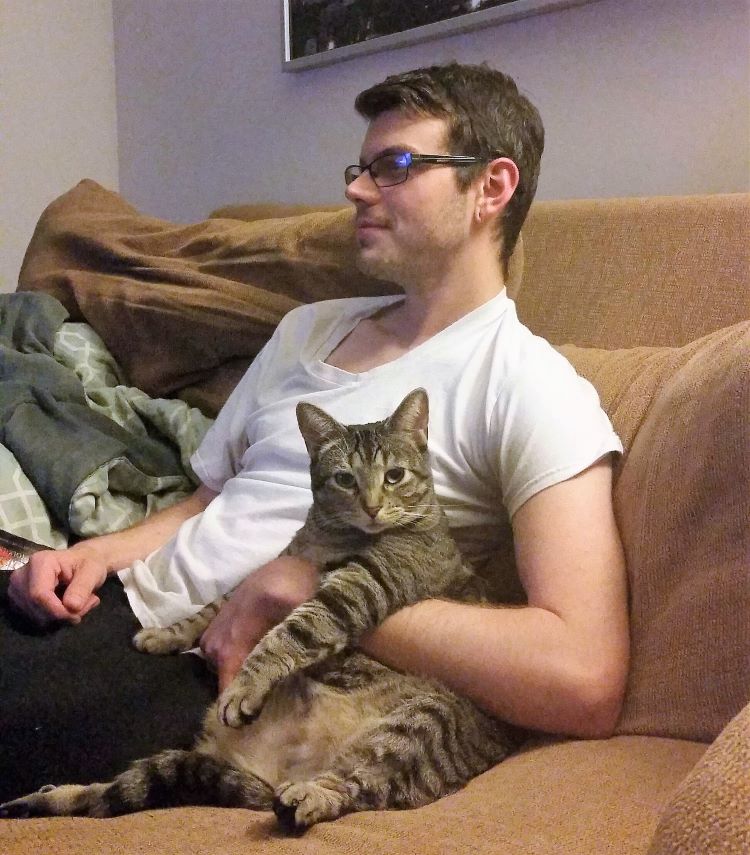
Bearing in mind that domestic cats rely on their sense of smell to identify objects and people, one reason why a family cat might prefer the husband over the wife is because the wife wears perfume and the husband does not wear aftershave. 

Wife feels like she is a 'side chick' to her husband because the family cat prefers him
Wife feels like she is a 'side chick' to her husband because the family cat prefers him. Photo: Imgur.


I would argue that it is far more common for a woman to mask their body odour compared to men. This may be having an important impact on the relationship between domestic cats and family members. 

I am speculating, of course, and I am not saying that domestic cats prefer husbands to wives. Far from it because when you research this point you will find that people are looking to Google for answers as to why a domestic cat prefers their girlfriend, or their roommate, or somebody else and it is always gender unspecific. 

This is not about human gender; it is, I believe, more about body odour! But there are many other factors why a cat prefers somebody over another person. It is about chemistry and we know that the word "chemistry" in relation to affection for a significant other is a very vague term. It means a bundle of factors that we can't necessarily specify.

But this 'chemistry' will be different the cats compared to people. The lives of people are dominated by what they see, for cats their sense of smell is certainly as important as their eyesight or perhaps more so. This is why you will see domestic cats constantly sniffing the legs of their human companion even when they know full well who that person is. They seem to be constantly reaffirming that this is the person they know. And they like the scent of that person. It's a reassurance.

Just this morning when I fed my cat with a treat after I came in from buying a newspaper, he sniffed at my leg on more than one occasion. I know that he loves the way I smell. It is just the way it is. And I don't wear aftershave. I never have. 

The range of factors which make up the chemistry between cat and person will include such things as: the sound of the person's voice, the way they handle their cat, whether they genuinely like their cat or not, whether they have raised their cat from a newborn kitten and so on. But I believe, to return to the beginning, that perhaps the most dominant factor is the scent of a person.

And the fact that cats can have chemistry with a human once again reaffirms that they are sentient beings. There are still people who believe that cats are not. But a recognition that domestic cats are sentient is so vitally important to their welfare. Once you accept that they are sentient beings with feelings it changes your perception of animals and it should make us more sensitive towards their needs and welfare.

Friday, March 12, 2021

Food freshness is important to a domestic cat

 I ran a little tests today to see how critically important food freshness is to a domestic cat. My cat likes king prawns. I treat him with them from time to time. I have one packet which has three days left on its sell by date so they are perfectly fresh and edible.

Food freshness is important to a domestic cat
Food freshness is important to a domestic cat. Image: MikB based on image from Pixabay.


Today I bought a fresh packet, straight off the shelves of Sainsbury's. I gave him some prawns from the older packet and he rejected them. I gave him some prawns from the fresh packet and he gobbled them up.

Both were highly edible but he entirely rejected one and loved the other. And of course he checked them out with his nose. The first thing that a domestic cat does when eating food is to smell it. The cat's nose is the arbiter of whether food is good or bad, edible or inedible.

This is why they will pick up the smell of a pill inside food and reject all the food or just the pill. I don't think humans have yet fully grasped the importance of smell to the domestic cat. It's like an extra pair of eyes in the human world.

I wonder sometimes whether they rely more on their sense of smell than they do on their sight. As I dictate this my cat has discovered some dry cat food inside a toy. The toy is designed to make getting at the food difficult. It's meant to simulate hunting. The food has been there for about a year. He is eating it with gusto.

That is another story. Dry cat food can smell perfectly edible and attractive to a domestic cat even though it is quite old and beyond its sell by date. Does dry cat food go off? They say it does and it does have a sell by date but I'm sure that 99.9% of purchasers ignore the sell by date. It is as good as meaningless because the lifespan of dry cat food is so long in practice.

The point of this post is that cats rely on their sense of smell to decide whether the food is edible or not. It's appearance is probably neither here nor there.

Search This Blog