Showing posts with label domestic cat size. Show all posts

Monday, September 25, 2023

Female, moggie rescue cat grew up to be as big as a big Maine Coon

This female, grey tabby, rescue cat looks a little like a big Maine Coon both in their strong, square muzzle and overall size at 17 pounds. She is a random-bred rescue cat. She was found in poor health but flourished in a great home where she is loved to become a monster!

Female rescue cat. A moggie who is loved and who weighs a reported 17 pounds but it looks more! Image: Quora.com.

She was trapped in July 2021 in the US with her three siblings. She's named Florence. They were living under a trailer in Fletcher. They had the usual URIs and were generally ill. They never thought she'd grow up to be so huge. She is adored.

There are some really large moggies out there. But it is rare to see a female this large. Very rare I'd say. I think she is the largest female moggie I have seen.

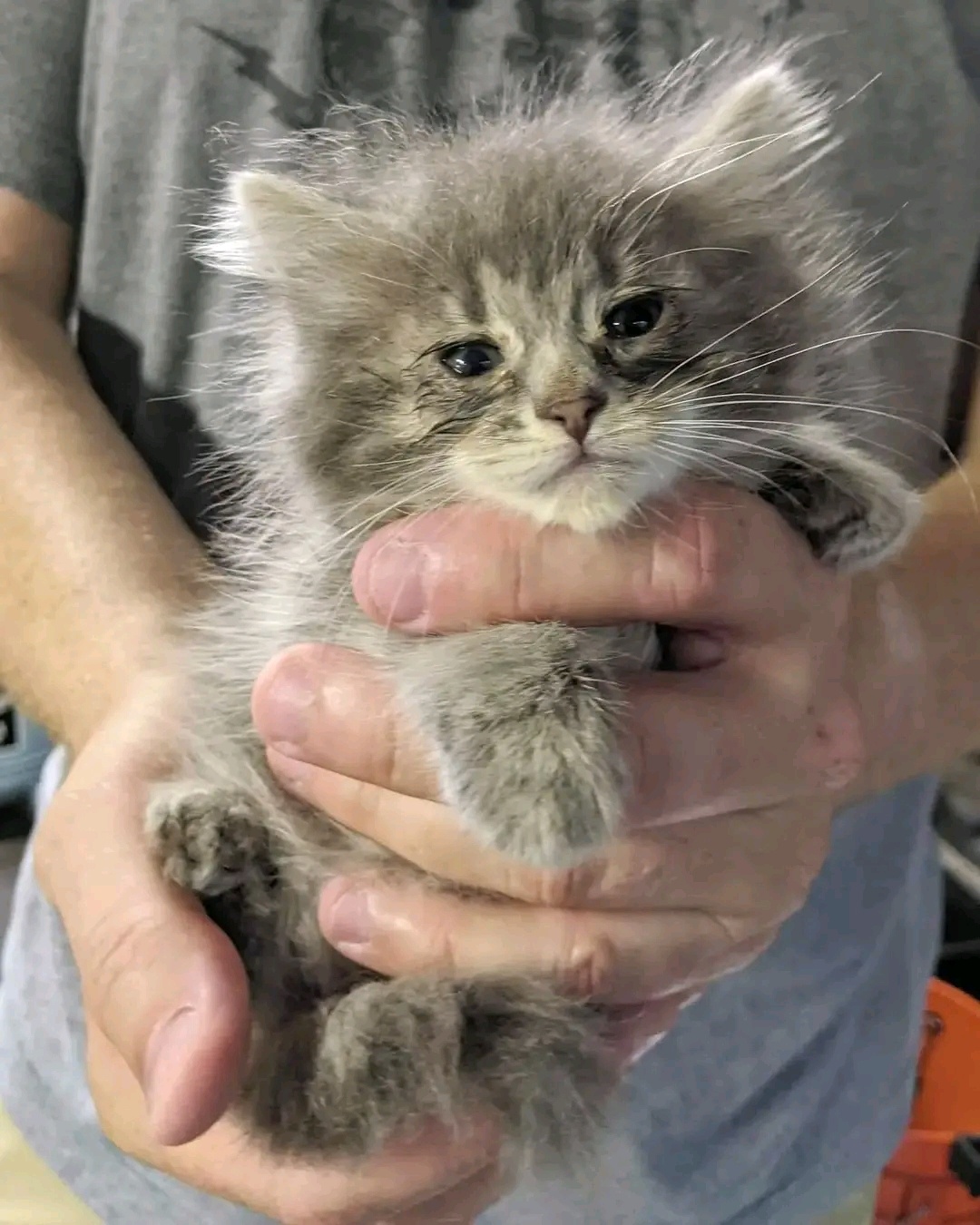
This is her when she was found:

Image: Quora.com.

Wednesday, May 5, 2021

Domestic cat's small size compared to humans' is a factor in our relationship

A study about aggressiveness in domestic dogs confirms what I have believed for a long time, namely that the relatively small size of the domestic cat in relation to the size of humans is an underlying factor which influences our relationship. What I say is that the domestic cat lives with the human-animal which towers over him or her and this can make them feel vulnerable sometimes, which in turn can lead to an underlying level of anxiety which may manifest itself in terms of defensive aggression.

Domestic cats often have to look up at their human towering over them
Domestic cats often have to look up at their human towering over them. Photo: Pixabay.


I think it is a plausible suggestion because if we imagine ourselves living with creatures 10 to 20 times bigger than ourselves it would certainly have an impact upon our sense of security, well-being and emotional state. It would have an impact upon the relationship in general.

It is up to human caretakers to ensure that they overcome this imbalance in size through a particularly gentle approach to interactions with the domestic cat companion. Also, it pays sometimes to get down to the same level as the domestic cat or to allow the cat to come up to the level of their human companion. The latter can be achieved if cat owners allow their cat to sleep on their bed with them. The human bed is a natural level up but it is sad to report that a lot of cat owners, even concerned cat owners, don't allow this.

The human bed is a natural place for a domestic cat to be. They can immerse themselves in the scent of their human and exchange this scent by depositing their scent onto the bed and receiving body odours of their human companions onto their fur. This is a delight for a domestic cat and it is reassuring.

So back to the dogs which I mentioned at the beginning of this article. A study that was conducted at the University of Helsinki found that in general the more aggressive dogs were the smaller ones while, conversely, the least aggressive were the larger dogs.

This, I would argue, fits in with the human analogy namely that men who are challenged vertically, to use politically correct language to be more aggressive than those who are tall or of normal height. The size and height of male humans is quite an important factor in their lives. The small individual needs to prove their worth and they can become more competitive, sometimes overly competitive and this can manifest itself in aggression. I think that is a fair analogy.

And another reason why domestic cat might become anxious because of vulnerability is because they depend entirely on their human caretaker. They put all their eggs into one basket. So they depend upon a giant to feed them, to keep them warm, to allow them to feel secure and provide emotional comfort. It's a slightly dodgy situation for a top predator to live with.

The most aggressive dogs are for example the miniature poodle, the miniature schnauzer, German shepherd, Spanish water dog, Chinese crested dog, for example while the least aggressive are dogs such as the Labrador retriever, golden retriever, Shetland sheepdog, Staffordshire bull terrier, Jack Russell terrier and the smooth collie.

So what can people do about this? At least be aware of it and modify behaviour when and where necessary to try and overcome this inherent physical barrier to the relationship. It certainly pays to get down to the level of your cat, sometimes. I know that in my personal experience my cat thoroughly enjoys it when I do this. 

His behaviour changes and it is noticeable. And when he is on my bed with me, either with me in bed or on top of the duvet cover, it is noticeable that he likes it. The message is clear because he trills and purrs and demonstrates excitement. I think it is because I am at his level, at his height and no longer dominating him through my physical presence.

Sunday, April 29, 2012

Domestic Cat and Mouse Picture

This photograph by Jo and Paul on Flickr, shows us very graphically the difference in size between the predator, the domestic cat and the prey, the little mouse.

It is not always the case that the predator is so dominant in terms of size. Think about the large wildcats, especially. Both the lion and tiger can and do take on prey that is many times larger than them. Lions will tackle Cape buffalo weighing 600 - 900 kilograms, while the average weight of tiger kills in Nagarahole National Park in India was 401 kilograms1. That is heavier than the heaviest tiger. However from the standpoint of survival the wildcat will prey on animals that offer the least resistance and chance of being injured during the attack. The serval is much like the domestic cat in preying on rodents in long grass using hearing as a major form of prey detection (servals have notably large ears).

The domestic cat has it easy. The mouse is the perfect meal for the domestic cat. Sometimes cats play with a mouse they are attacking, even when it has been killed. This is seen as cruel by people.

Large black calico cat and tiny mouse - Photo by Jo and Paul's pics

Cats don't think it terms of cruelty.  There are good and reasonable reasons why both the domestic cat and the smaller wildcats play with prey before and after it has been killed.

You can read about it on this page: Domestic cat hunting.

Associated: Lion prey Kruger NP.

Note: 1 Wild Cats Of The World by the Sunquists

Friday, November 18, 2011

Why are domestic cats the same size?

Domestic cats are usually of a similar size (with some exceptions) because all of them, except the wild cat hybrids, originally come from the the Eurasian and/or African wildcats. These are both small wildcats that still look like domestic cats.

They were domesticated about 9 to 5 thousand years ago and nothing has really changed that much to change the size of the domestic cat since. There has been some development in selectively breeding for size in the larger domestic cats such as the Maine Coon. But the Singapura is a small domestic cat which is less than half the size of the Maine Coon. So it is not quite right to say that domestic cats are the same size.

The only big changes in domestic cat size have been in respect of the creation and development of wildcat hybrids. This entails crossing a domestic cat with a medium sized wild cat, the serval, in the case of the Savannah cat. When you introduce a fairly large cat, the serval, into the breeding program you will get at first generation (the offspring of the serval father and domestic cat mother) a very large domestic cat. The safari cat is another example.

The well known Magic, a first filial Savannah cat and the world's largest domestic, is the classic example.

Associated page: Largest Domestic Cat Breed

Search This Blog