Showing posts with label personality. Show all posts

Saturday, August 12, 2023

Do male and female cats have different characters?

They do have slightly different personalities in general in my opinion but I've asked the question because the American Animal Hospital Association Encyclopaedia of Cat Health and Care states that "There are no sex-linked character differences between male and female cats". They add that "both male and female cats are loving and companionable [and] altered cats may become an even more attentive and affectionate pet".

Difference between male and female cats in terms of distance travelled from home. Image: Admiral Insurance.

Home range

I think that they're slightly wrong to be fair. Even after being neutered, male cats are likely to want a bigger home range than female cats. They want a larger area that they call their own. This means that if they are allowed outside unsupervised - and many domestic cats still are nowadays - they will roam wider and further than female cats.

Risk

This exposes them to more risks than female cats. Another behavioural trait of male cats compared to female cats is that they can be more aggressive which means they are likely to get into more fights in defending their territory against invading cats. This will also expose them to more health risks.

Stand-offish?

And it is said that female cats can be little more standoffish and even less friendly than male cats. I can't find any hard scientific facts about that so will call it anecdotal. That means that cat owners report it.

RELATED: Are male cats more affectionate with humans and other cats than females?

Ginger tabby

Interestingly, it is said that the ginger tabby domestic cat is a friendly cat. It is said that their character is linked to their appearance which is unusual but there is evidence to suggest that this is true.

And 80% of ginger tabby cats are male. This would support what I have just stated above. But, then again, female cats are more gentle than male cats. 

Tortoiseshell

There is another interesting coat type which is sex-linked namely the tortoiseshell and tortoiseshell-and-white coat. These cats are nearly always female because of the way the genetics work. You can read about that if you like by clicking on this link.

1 in 3000 rare male calico cat in the hands of an Asian vet. Image: Twitter.

But the point is this: it is said, anecdotally again, that tortoiseshell cats have what cat lovers call "catitude". This, as you might expect, means a cat with attitude. A little bit feisty perhaps. Perhaps a little more independent and minded to do their own thing and be less obedient. So, this perhaps adds to the notion that female cats are slightly less friendly than male cats if you bring into the equation all of the tortoiseshell and tortoiseshell-and-white cats.

Confidence and timidity

Because they're less likely to roam far and wide I think we can say that female cats are more timid in general but one must observe the simple fact that each cat has their own personality. It is very difficult to generalise about the differences between male and female cats in terms of character or personality.

The more timid cat is not going to get into so much trouble. They're going to be more pliable and gentler with their owner; perhaps desiring more to be on their owner's lap. But once again, whether a domestic cat is a lap cat or not cuts across the gender of the cat. It is not sex-linked as they say.

90% the same

I think it's fair to say that male and female cat characters are 90% or more the same. There will be some slight differences, in general, in terms of aggression, self-confidence, outgoing behaviour perhaps, lack of timidity and so on.

Prefer females

Personally, although I currently live with a male former-feral cat, I prefer female cats because they are more gentle and less likely to get lost. There is another point worth mentioning. If I am correct in saying that male cats like to roam further than female cats then they are more likely to get lost I would argue. The female cat will stay nearer home and be less adventurous which, for me, is a great asset in terms of peace of mind if, as I do, you have a cat flap and let your cat go outside unsupervised.

Females/mothers

Image:MikeB

I hope this helps. I would love you to share your views on the difference between male and female character.

Monday, July 11, 2022

Not all domestic cats are equal in their athleticism, confidence or intelligence

This is a popular video on Twitter which reminds us that not all domestic cats are equal in their athleticism or is it something else? They appear not to be equal in terms of their athleticism but perhaps they are not the same in terms of their personalities or intelligence.

2 types of cat
2 types of cat. Screenshot.

Each is an individual. Some cats are incredibly athletic while others are a little more clumsy but nonetheless very endearing. We don't mind if our cat is not athletic, we love him or her just the same. By and large domestic cats are very competent athletes. 

The difference in this video may partly be due to the differences in intelligence between the two cats. Or perhaps it is more likely that there is a difference in confidence. 

The first cat is less confident than the second. The first cat needs to climb up onto that crossbar and then haul himself over whereas the second cat is confident enough to target that tiny space and place their forepaws precisely on that crossbar and then jump off. 

This requires a high level of precision and precision requires confidence. We know that there is a difference in the domestic cat in respect of their confidence levels, which expressed another way means that some cats are outgoing while others are more timid. This is an embedded video from Twitter. Very often they stop working but a link remains to the video on Twitter itself. If that has happened, I apologise but simply click on the link and you should be able to see the video which I think is amusing and instructive.

Monday, December 13, 2021

Example of how an animal shelter assessed a kitten's personality incorrectly

Below are the words of an anonymous person. I really do not know who wrote them. Also, they made this statement about five years ago so this is now history. It was a draft article which I never completed. I thought this woman's words should not be deleted and so decided to publish them on this subdomain website. They are wise words. Words that warn of the difficulty in assessing animal personality at shelters.

This is about as sad a photo as you'll see of a cat at an animal shelter awaiting adoption or death.
This is about as sad a photo as you'll see of a cat at an animal shelter awaiting adoption or death. Photo taken by: Delanie Pruit.

They are telling words because they remind me that not uncommonly shelter staff assess kittens and adult cats incorrectly as to their adaptability based upon their character. We don't know how often this happens but it is certain that hundreds of thousands (millions?) of shelter cats and dogs, on the planet, or perhaps just in the USA, UK and Europe are killed unnecessarily because they have been incorrectly assessed as feral or with behavioural problems.

RELATED: Delightful Cat Deemed Unadoptable By Animal Shelter Stress.

We all know that an animal shelter environment is not the best place to assess the character of an animal. They are stressful places. They are strange and noisy places. The whole experience is going to make even the best of cats nervous and how can a nervous cat present their best to an adopter? 

And if the cat is already slightly nervous and anxious the whole thing may just make them completely unadoptable. But take them out of the shelter environment into a foster home and you might be lucky to see the true character. How many times have you seen shelter cats described as aggressive and then re-assessed as being the friendliest cat that they have met?

RELATED: Temperament Testing Of Cats.

The story

"I recently saw a kitten listed on the Philly Urgents page. They list cats and dogs that don’t have much time left. This kitten would have been killed that night after closing if someone didn’t take her. Since I work with ferals, I went to get her, aiming to socialize and find her a home. 

She had a big sign across her cage that said, “Barn Cat Only.” I asked the shelter staff if she came in with a litter, worried that any other would be killed. 

She did come in with 2…one was already gone. When I met the other and saw how friendly she was, I knew they had made a mistake with the other.

I brought them both home. It didn’t take long to realize that the feral cat was just a shy little girl, but one of the friendliest cats I’ve ever had the pleasure of handling! 

She just needed her sister to help her relax, because she was sick and has vision trouble in one eye. How sad that she was going to be killed."

Sunday, July 18, 2021

Cat coat colour and personality stereotyping

'You can't judge a cat by its colour' is the mantra to follow at a cat shelter. Adopters should spend time with cats at shelters and not prejudge using stereotyping. Some people judge domestic cats by their coat colour but there is little evidence that a cat's coat type and colour has an effect on personality. 

White cats stereotyped as aloof
Male white British Longhair cat bred in Russia by the Golden Leris cattery. Photo:  ΠŸΠΈΡ‚ΠΎΠΌΠ½ΠΈΠΊ британских кошСк Golden Leris located in Moscow, Russia. White cats seen as aloof.


It is anecdotal and stereotypes circulate on the internet. The trouble is that typecasting cats by their colour has implications at cat shelters. We know the colours which are the least popular such as black. Here are some more associations between colour and personality:
  • Orange cats (usually orange or red tabbies) are stereotyped as friendly;
  • Black, white and tricolour (tortoiseshell) cats are stereotyped as being antisocial;
  • Black cats are regarded as having less extreme character traits;
  • White cats are typecast as being aloof, shy, lazy, and calm;
  • Tortoiseshell cats are regarded as being intolerant ('catitude) and are more trainable.
The lead author of a study, Delgado, on this stereotyping said: "To date there is little evidence that these perceived differences between differently colored cats actually exist, but there are serious repercussions for cats if people believe that some cat colors are friendlier than others...".

Perhaps it is time for a definitive study on the link between coat type and color and the cat's personality if a link exists. 

Red tabbies are regarded as 'leadership material'! (my thoughts). 

Tortoiseshell and calico cats (tortoiseshell-and-white) cats are widely seen as having an attitude problem of sorts. 

Black cats are seen as bring bad luck. A stupid throwback to the Middle Ages. You'd think that by now people would have given up this absurd stereotype. 

Delgado and his fellow researchers used Craigslist to reach out to cat owners, requesting them to rate on a scale of 1 to 7 the personalities of black, white, bicolor, tricolor (tortoiseshell) and orange cats using the following traits: active, aloof, bold, calm, friendly, intolerant, shy, stubborn, tolerant and trainable. 

Most participants said that personality was an important factor in selecting a cat to adopt but coat color played an unconscious or conscious role in that choice. 

When more than one black cat is in a shelter adoption room few adoptions take place said Berkeley East Bay Humane Society (BEBHS) cat coordinator Cathy Marden.

Friday, February 19, 2021

Are Bengal cats dangerous?

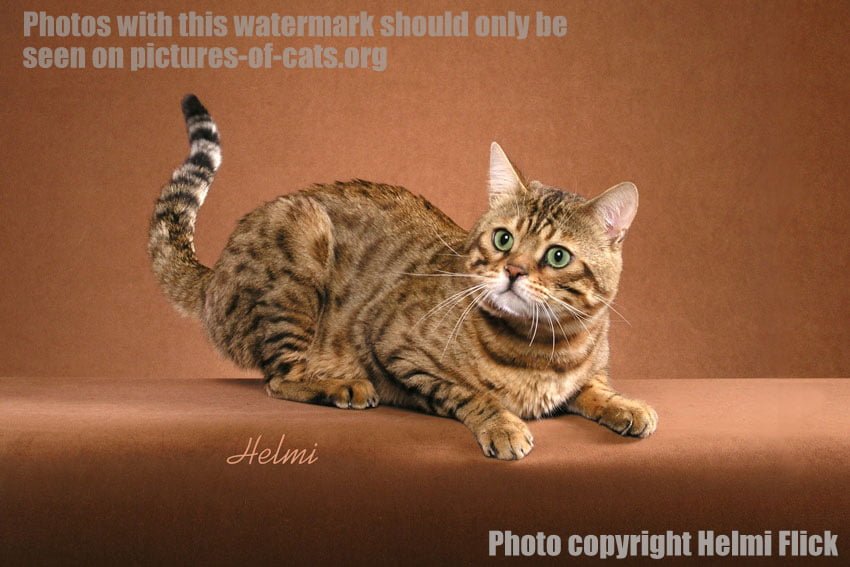
Bengal cats are not dangerous but it does depend on how you interact with them and whether we are referring to F1 or F5 Bengal cats and finally whether we are referring to Bengal cats being a danger to other cats or people.

Bengal cat
Bengal cat

Fifth filial (F5) Bengal cats are pretty well like any other standard domestic cat. Treat them nicely and they will be nice back to you. There is nothing more to say particularly about this breed of cat except perhaps that they are liable to be more athletic than your standard random read cat. I say "liable" because that does not apply in every instance. And because they're more athletic they are more inclined perhaps to get into trouble or break out of cat confinement fences if you've taken the trouble and time to build an enclosure in your back garden.

If you adopt a first filial (F1) cat it is a different proposition (note: license required in the UK and elsewhere probably). The father of these cats is an Asiatic leopard cat and there is a lot of wild cat DNA in them which makes them more difficult to handle and live with. They may be dangerous if you mishandle them and mishandling them is more likely because they are more demanding. This applies to all first filial wild cat hybrids by the way.

I would not advise the average person to adopt a first filial wild cat hybrid for this reason. They require more time, money, patience and commitment than standard cats. Most people want a cat companion to be placid, somewhat docile and friendly all the time. They don't want to be challenged and have demands placed upon them. That's why I would go for a well socialised random bred cat from a rescue centre compared to a glamorous and highly expensive F1 Bengal cat or Savannah cat.

It may be argued that F5 Bengal cats are more territorial than your standard domestic cat companion. This means that if they go outside to wander freely they may be more aggressive towards other cats doing the same thing. There is, however, an argument that people should not let the Bengal cats go outside because they are too expensive, too glamorous and more liable to be stolen. Keep them inside and they would not be in a position to attack a neighbour's cat.

That said, there are complications in keeping an active F5 Bengal cat inside a home because I think they demand more space and challenges than that. Therefore an F5 Bengal cat owner has a dilemma. If you let them out there may get stolen and if you keep them in they may be bored and they place more demands upon the owner. 

I may be unfair because as mentioned the Bengal cat is ultimately very similar to any other domestic cat. But that said again domestic cats need challenges and entertaining and being confined to the home that does place automatic extra obligations upon the owner in order to stimulate them mentally and physically.

So back to the question in the title. The answer has to be a no, they are not more dangerous than any other but they are possibly more challenging and more demanding even at the F5 level which means that you have to interact with them in the right way. I suppose it is fair to say that a Bengal cat might be more dangerous in one sense and that you might be more liable to be scratched than if you live with a very placid female Ragdoll cat for example.


There is a Daily Mail article about the aggressiveness of the Bengal cat. It is highly misleading in my view. It is exaggerated. They paint a picture of a cat which is diabolical to live with, attacking other cats willy-nilly. They say that cat breeders have bred a cat which is deliberately aggressive and with heightened hunting skills. Wrong!

Bengal cat
Bengal cat

In my view, cat breeders have tried to breed Bengal cats which are the opposite. They want to create cat companions which are suitable for living in the home in which are friendly and gentle towards their owners. It is entirely inappropriate to claim that breeders are selectively breeding Bengal cats which are highly aggressive. This may be out of ignorance but it does tend to put people off this breed which is unfair in my view.

That said, the Bengal cat is probably more territorial than your standard domestic cat and therefore if it is outside they may attack other cats for territorial reasons more commonly than other cats.

Search This Blog