Showing posts with label cat breeding. Show all posts

Sunday, August 27, 2023

Are female ginger cats rare?

The question refers to domestic cats and the belief that the ginger coat colour (called 'red' by the cat fancy) is sex linked meaning that red tabbies and solid reds are usually male. 

Red spotted tabby Oriental SH
Lithe, svelte red tabby Oriental Shorthair. Photo: ARN.

I would like to refer to Sarah Hartwell of the messybeast.com website on the matter of ginger cat genetics and the reason why there are more male ginger cats than female ginger cats. Here is her explanation:

The ginger gene changes black pigment into a reddish pigment. The ginger gene is carried on the X chromosome. A normal male cat has XY genetic makeup so he only needs to inherit one ginger gene for him to be a ginger cat. A normal female is XX genetic makeup so she must inherit two ginger genes to be a ginger cat. If she inherits only one ginger gene, she will be tortoiseshell with some ginger areas and some black/brown areas.

Thanks Sarah. If you'd like to see her webpage on this please click here.

She confirms that female ginger domestic cats are less common than male ginger domestic cats but they are NOT rare.

Breeders can mate ginger males and ginger females to produce ginger offspring. 

So, what percentage of ginger cats are male? Sarah does not provide an answer to that question but it seems to be about an 80:20 percent split in favour of males.

If that is accurate about one fifth (1 in 5) of red tabby and solid red domestic cats are female and four fifths (4 in 5) are male.

Hope this helps.

Saturday, May 22, 2021

Do wild cats breed with domestic cats?

The question is asking whether any one of the 36 or 37 wild cat species is able to mate with a domestic cat to create a wild cat hybrid? And the answer is yes but it depends upon the wild cat species. Not all can mate with domestic cats. 

The best known small wild cat species that can successfully mate with the domestic cat are: the serval producing the Savannah cat, the leopard cat producing the Bengal cat, the jungle cat producing the Chausie and Geoffroy’s cat producing the Safari cat. As it happens, I have a fairly comprehensive list on another page which you can read by clicking on this link. You can read about these cat breeds by clicking here.

Loki an abandoned high filial Savannah cat. At BCR now. Safe but anxious
Loki an abandoned high filial Savannah cat. At BCR (Big Cat Rescue) now. Safe but anxious. Photo in public domain.

The size of the wildcat is a factor on whether it can successfully mate with the much smaller domestic cat. For example, the serval is a medium-to-large wild cat. The male serval does mate with the domestic cat in breeding catteries to create the F1 Savannah but these wild cat hybrids are very expensive at around $20,000, which tells us that the mating of these two cat species is problematic. We don't know how many failures there are and how cruel the process is. It is unnatural for sure. The physical issues would seem to be a barrier to me. 

Perhaps the best known and most popular wild cat hybrid is the Bengal which is a mainstream cat breed these days. But you'll be adopting an F5 normally; a cat with little wild cat DNA in her. They are very similar to regular domestic cats. F1 Bengal cats are as are all the first filial wild cat hybrids.

There was some resistance to accepting them in the fancy as there were fears that they'd be too wild and aggressive. That fear has subsided and the wild cat hybrid is now fully accepted and the high filials are considered exotic animals to treasure. They are status symbols for the rich.

There is actually a problem with the Scottish wildcat mating with outside domestic cats and feral cats producing hybrids which the world does not want because they are non-purebred Scottish wildcats and the look like the genuine article. 

In Africa the African wildcats often mate with domestic cats living in settlements. These are all hybrids and so you end up with the purity of the African wildcat being diluted and not knowing for sure which individual cats are purebred or not. In other words, the conservation of the African wildcat on the continent of Africa is being undermined by this hybridisation which takes place informally.


Friday, February 19, 2021

Are Bengal cats dangerous?

Bengal cats are not dangerous but it does depend on how you interact with them and whether we are referring to F1 or F5 Bengal cats and finally whether we are referring to Bengal cats being a danger to other cats or people.

Bengal cat
Bengal cat

Fifth filial (F5) Bengal cats are pretty well like any other standard domestic cat. Treat them nicely and they will be nice back to you. There is nothing more to say particularly about this breed of cat except perhaps that they are liable to be more athletic than your standard random read cat. I say "liable" because that does not apply in every instance. And because they're more athletic they are more inclined perhaps to get into trouble or break out of cat confinement fences if you've taken the trouble and time to build an enclosure in your back garden.

If you adopt a first filial (F1) cat it is a different proposition (note: license required in the UK and elsewhere probably). The father of these cats is an Asiatic leopard cat and there is a lot of wild cat DNA in them which makes them more difficult to handle and live with. They may be dangerous if you mishandle them and mishandling them is more likely because they are more demanding. This applies to all first filial wild cat hybrids by the way.

I would not advise the average person to adopt a first filial wild cat hybrid for this reason. They require more time, money, patience and commitment than standard cats. Most people want a cat companion to be placid, somewhat docile and friendly all the time. They don't want to be challenged and have demands placed upon them. That's why I would go for a well socialised random bred cat from a rescue centre compared to a glamorous and highly expensive F1 Bengal cat or Savannah cat.

It may be argued that F5 Bengal cats are more territorial than your standard domestic cat companion. This means that if they go outside to wander freely they may be more aggressive towards other cats doing the same thing. There is, however, an argument that people should not let the Bengal cats go outside because they are too expensive, too glamorous and more liable to be stolen. Keep them inside and they would not be in a position to attack a neighbour's cat.

That said, there are complications in keeping an active F5 Bengal cat inside a home because I think they demand more space and challenges than that. Therefore an F5 Bengal cat owner has a dilemma. If you let them out there may get stolen and if you keep them in they may be bored and they place more demands upon the owner. 

I may be unfair because as mentioned the Bengal cat is ultimately very similar to any other domestic cat. But that said again domestic cats need challenges and entertaining and being confined to the home that does place automatic extra obligations upon the owner in order to stimulate them mentally and physically.

So back to the question in the title. The answer has to be a no, they are not more dangerous than any other but they are possibly more challenging and more demanding even at the F5 level which means that you have to interact with them in the right way. I suppose it is fair to say that a Bengal cat might be more dangerous in one sense and that you might be more liable to be scratched than if you live with a very placid female Ragdoll cat for example.


There is a Daily Mail article about the aggressiveness of the Bengal cat. It is highly misleading in my view. It is exaggerated. They paint a picture of a cat which is diabolical to live with, attacking other cats willy-nilly. They say that cat breeders have bred a cat which is deliberately aggressive and with heightened hunting skills. Wrong!

Bengal cat
Bengal cat

In my view, cat breeders have tried to breed Bengal cats which are the opposite. They want to create cat companions which are suitable for living in the home in which are friendly and gentle towards their owners. It is entirely inappropriate to claim that breeders are selectively breeding Bengal cats which are highly aggressive. This may be out of ignorance but it does tend to put people off this breed which is unfair in my view.

That said, the Bengal cat is probably more territorial than your standard domestic cat and therefore if it is outside they may attack other cats for territorial reasons more commonly than other cats.

Wednesday, May 30, 2012

Singapura Cat Picture

The amazingly large eyes in relation to the head size is a bit surprising in this excellent Singapura cat picture by Sakura Ishihara on Flickr. The picture is titled:

シンガプーラのジジちゃん in Japanese (I think!). Sakura is a cat photographer.

Singapura cat

I actually took the extreme liberty to adjust the photograph; fading the edges away a bit and darkening the highlights a bit too.

I have never seen a domestic cat with such large eyes in relation to head size before. With respect to the breeder, it looks a little exaggerated. I am not sure if there are health issues.

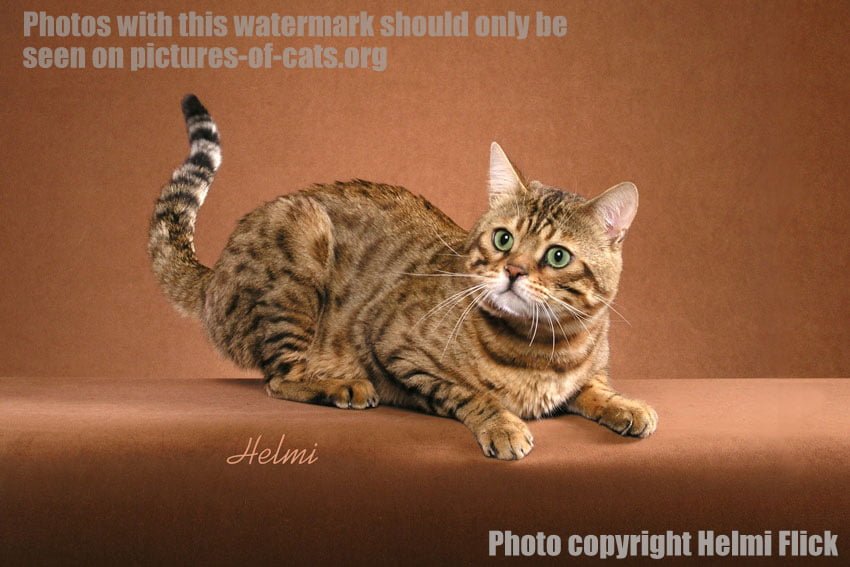
You can see an American show cat photograph by the professional cat photographer Helmi Flick on this page and a lot of detail about this cat breed, the smallest cat breed, on this page.

The history of the Singapura is clouded in mystery and a bit scandalous. No that is too strong a word but the big question is: is this cat breed "manufactured" (hybrid selective breeding etc.) or was it discovered in the drains of Singapore? The Singapura is quite a rare cat breed.

Thursday, May 24, 2012

Sphynx Cat versus Don Sphynx Cat

Overview

I am writing about two fairly rare cats here. I would expect that there are not that many people within the entire cat keeping population who keep either of these cat breeds. Of the two, the Sphynx is the better known. In fact you will find that the Don Sphynx is not mentioned in most of the books that you can buy in the West about cat breeds. If an author of a book about cat breeds writes about hairless cats, it is the Sphynx that is featured.

One reason for this is that the history of the Sphynx is part of the history of North America, while the Don Sphynx is Russian. Although there is a lively cat fancy in Russia, the largest cat fancy and largest domestic cat market place is North America. Therefore cats get discussed more in North America. Also more books about cats are written in English and therefore more widely circulated. Accordingly the Sphynx becomes better known. Although in Russia, a somewhat closed-off society still in 2012, no doubt the Don Sphynx is what people first think of when they think of a hairless cat.


Appearance

Straight off, you probably would not see a difference between the Sphynx and Don Sphynx. I struggle to find real differences. My personal view is that a person thinking about adopting a hairless cat need not be overly concerned with the fine differences in appearance between these two cat breeds.

Referring to the breed standards tells us that they are very similar. The Cat Fanciers' Association (CFA), in the general section of their breed standard, says that this is a medium sized hairless cat that is warm to touch with a skin texture that is "soft peach or smooth nectarine". They say the cat is "sweet tempered and amenable to handling" and has "surprising weight for its size".

In America, TICA recognise the Don Sphynx (AKA "Donsky", another name for the breed) under preliminary new breeds .  They have a breed standard. However, I'll refer to the general description of the breed standard of FIFe, which is a European cat association. The author says that, "The Don Sphynx is a solid cat, soft and warm to the touch. The specific feature is hairlessness".

As I said there is almost nothing to tell them apart in general. Note: the hairless coat of the Donsky takes four forms. "All but one results in hairlessness". So one version is not hairless. You will find that hairlessness in cats does vary. It is the same with the Rex cats which also have a mutation that affects the coat. However, I am sure your breeder will ensure that you cat is hairless as demanded in the breed standard.

History

As mentioned, the cats' history is the real difference but one that is not hugely relevant. The Don Sphynx is essentially Russian and the Sphynx North American. The history of the Sphynx is a bit confused so I want go over it in detail here. Suffice to say that the Sphynx is a selectively breed cat that started life as a mutated random bred cat discovered in Minnesota, America in 1975 and in Canada in 1966 and 1978 (source: Legacy of the Cat). The mutation that causes hairlessness in cats is not that unusual as can be seen. It just so happened that a breeder decided to create a cat breed from that mutation. 

The Don Sphynx has a similar history but in a different part of the world; a mutated random bred cat was picked up by a breeder in Rostov-on-Don in Russia in 1987. Rostov-on-Don is in western Russia near Europe. In fact that part of Russia is considered European.

Genetics 

This is another major area of difference between these cat breeds. A recessive gene causes the hairlessness in the Sphynx while it is a dominant gene in the Donsky. That should make breeding easier for the Don Sphynx and there should be more hairless cats of Don Sphynx type roaming around Russia.

However, I don't think the genetic reasons for the hairlessness are of importance to people who wish to adopt a cat. The genetics of a cat (its "genotype") is the concern of cat breeders not cat caretakers.

Saturday, April 21, 2012

Small Girl Carries Big Cat

This is an outtake from videos made by me with video material generously provided by Kathrin Stucki of A1 Savannahs. A1 Savannahs is the premier Savannah cat breeders in the world and they are located near Ponca City, Oklahoma, USA. Oklahoma has a wide open landscape with a big sky; and a warm wind.

Leonie is Martin and Kathrin's daughter. She has grown up a bit since this video was filmed. I think she looks very cute carrying Magic, a female F1 Savannah cat, raised at A1 Savannahs who was soon, at the time of filming, to become the world's biggest domestic cat and the world's most celebrated and exotic domestic cat.
You have probably seen Andreas with Magic in the famous boy/cat relationship video also made by me with video material filmed by Kathrin.

You can see that Magic is a beautiful cat in more ways than just appearance. She has a great character. She was socialised really professionally. Being a first filial wildcat hybrid she has a lot of wild cat serval in her yet she behaves in many respects like a docile domestic cat.

In the video you see her rubbing her head against a towel. This is scent exchange. I think the towel may be impregnated with catnip as she seems very animated. She is crazy about it.

Wednesday, April 18, 2012

Three Valuable Savannah Kittens

A picture of three valuable Savannah kittens. I say valuable because these are special cats. They are at the very top end in terms of quality and when they grew up they no doubt went to great homes with, I hope, cat caretakers that are of equal quality!

Three Super High Quality Savannah Kittens
Three classy Savannah kittens - Photo: Michael at PoC.

Anyone is free to use the picture under a creative commons license provided it is used "as is" and a link and credit given. In fact you can hot link to this image because it is a direct link from Flickr and Flickr lets you use their website as a server. This by the way is the Flickr page. These darlings where being socialised at A1 Savannahs. There were born and raised at A1 Savannahs.

You can see how the coats change. The coats of these kittens are undeveloped. The contrast has yet to develop as have the spots. Servals have deep, rich spots and the objective of the Savannah cat breeder is to mimic that. This is not the same objective as the Bengal cat breeder.

As I said, these kittens are expensive. Why is that? Well, it is hard to breed savannah cats that have a high percentage of wild cat in them. These are rare cats and keeping servals (the wild cat parent) is difficult and expensive too. Servals, though, are relatively gentle medium sized wild cats and sometimes domesticated. Personally I find them a little intimidating to be next to if they are semi-wild. There are only a few breeders who do this successfully.

The famous Magic is probably the epitome of what the Savannah cat breeder is aiming for:


Tuesday, April 17, 2012

Real Calvin and Hobbes Picture

This is the real life Calvin and Hobbes. If you have seen the well known video, I apologize. This is a still from an outtake of video material made with a Flip camcorder - not bad quality under the circumstances.

I don't think there is anything approaching this on the internet. It was taken some time ago but is still worth publishing. I have been meaning to do this for a while. The boy is Andreas, the son of Martin and Kathrin Stucki and the cat is the famous, Magic, at one time the Guinness World Record largest domestic cat and a female F1 Savannah cat. They had a great relationship as is clear from this picture and the videos. Both Andreas and Magic were raised by Martin and Kathrin at A1 Savannahs, Ponca City, OK, USA.

Calvin and Hobbes: Fiction and Reality. Montage: Michael at PoC.

If anyone wants to use this montage they can but please link back to this page and provide a credit: "Montage by Michael at Pictures-of-cats.org (PoC)".  I don't expect anyone will! You will also have to justify publishing the cover of the book as has Wikipedia. I have adopted their arguments.

Note: I adopt the arguments of the Wikipedia authors in justifying the publication of the Calvin and Hobbes book cover in the illustration above. The real Calvin and Hobbes picture is taken from a Flip camcorder video by Kathrin Stucki of A1 Savannahs, Ponca City, Oklahoma, USA.

A bit about Calvin and Hobbes: Calvin is the precocious 6 year old boy and Hobbes the tiger. To Calvin, Hobbes is alive and humanized (here goes..anthropomorphized..). To other people Hobbes is simply a stuffed tiger. I guess imagination can take you there. And it gave the author and artist, Bill Watterson a medium through which he expressed some of his principled ideas.

Calvin had alter egos. In his mind he was someone else.  His parents were standard, middle of the road, middle class Americans; a foil against the exotic Calvin.

Bill Watterson was a bored and frustrated advertising executive. His mind took flight and he had the courage to get out and create the now famous Calvin and Hobbes. It was a tough road at the beginning it seems as his work was first rejected. Isn't it always that way?

Sunday, April 15, 2012

Kitten Stare

Kitten Stare by broadsurf
Kitten Stare, a photo by broadsurf on Flickr.
Gorgeous F2 Savannah kitten playing at home. He is being socialised. He has a very intense stare. Perhaps this is the look of a wild cat hybrid.

"F2" means second generation from the wild cat serval. So there is quite a bit of serval in this little charmer. I had lots of fun photographing these kittens. They were very inquisitive and active. What else?

The photograph was taken at the home of Martin and Kathrin Stucki owners of A1 Savannahs. The kittens are socialised at their home. He is playing on one of the chairs. This was a very nice chair. One thing about this chair that we all recognised was dangerous was that it was a recliner and one or perhaps two of the kittens had a habit of crawling into the mechanism space under the sofa. That could prove very dangerous so it was locked into a static position as I recall. This eliminated the danger. This is the kind of thing you have to watch out for when kittens are growing up.

The original picture is in colour but I like it in black and white for some reason. See more Savannah cats and detailed information.

Monday, January 30, 2012

Ugly Cat Picture

The ugly cat picture is one of the many internet cults along the lines of the cheeseburger LOL pics. Many people like them but the cult is dying. Personally I don't like them. Sorry to be a killjoy. I just see either a sick cat, or a wet cat or a photoshopped cat or a badly bred cat with no future.

Ugly cat Yoda
Uglly cat Yoda. Image in public domain

I don't know a thing about Yoda except this: he is bloody ugly. But what a shame. Someone created him. Shame on them. I feel sorry for Yoda. Although he does not feel sorry for himself as ugliness is a human concept. He appears to be a cat breeding nightmare mistake as nearly all ugly cats are. Read on please....

The first picture looks like a modern Siamese cat or an Oriental Shorthair that is patently overbred even for a cat that is already overdone:

Ugly cat? Yes, and because of misplaced selective breeding. Think of the cat. 

Above: I am not sure I would call this cat an ugly cat, actually. More a sad cat. Breeders like to breed large ears and an oriental style face (long). This fella has a very bony long face that looks artificial and the ears are horribly unnatural.

Ugly cat or sick cat?

The cat immediately above looks like a poorly bred orange tabby Exotic Shorthair with tear duct overflow and jaw misalignment. This is a cat that suffers because of irresponsible breeding and to call the cat ugly is unfair. Apparently deformities of the jaw or teeth are a hazard in breeding the Exotic Shorthair. I mention that on this page: Tabby and White Exotic Shorthair Cat. The picture below is another horrible mess of an attempt to breed a flat faced cat, probably the modern Persian. Madness. We don't see these failed attempts do we?


Badly bred Persian with jaw misalignment and tear duct overflow and more I suspect. A mess.


Ugly cat - yes I agree


Looks like a hairless cat that went wrong. Picture in public domain


The 4th and 5th of this fivesome are genuinely ugly. The 4th one is a very peculiar looking cat. The picture looks genuine. There are elements of the face that indicates that this cat is meant to be a Sphynx or a Peterbald (with a brush coat). But who knows? This cat could just be one of those anomalies. The hair is very thin so it might be hairless on a seasonal basis. He appears to have been in a fight as he has a scar on the nose. I could say the same about the 5th and last cat. A mess of a human creation. Botchy humans at the cat's expense.

Sunday, January 8, 2012

Picture of Ragdoll Cat at a Cat Show

Cat show cat - Photo Tomi Tapio

The photographer says "very nice nose". And I agree. I think this is a purebred Ragdoll show cat with, yes, a really nice nose. We shouldn't get too excited about a nose though! That said show cats are all about appearance so noses and all the other elements of a cat's physical appearance are important. This cat seems to be a blue pointed Ragdoll. This is a large semi-long haired cat with a laid back character. Back to the nose: I can think of a similar cat that has a nose that is much less attractive: the flat-faced Persian (ultra typed Persian). The picture below shows you what I mean:
Ugly nose? Photo protected by copyright.

How did breeders decide that the appearance of this overbred Persian was attractive? This was created deliberately. Come of ladies, let's go back to a nice nose...!

Picture of Bizarre Overbred Cat

In the public domain as far as I am aware

I am told that this is a picture of an overbred cat. His name is Yoda. I really don't know what to make of this. Is it real? It looks real - just. Would over-breeding do this to a cat? Possibly. This cat has thin fur. I may be the case that the breeder was breeding hairless cats and over did the breeding process. Not sure. All I know is that it is horrible. But no doubt it is of interest to some people, which is why I have put it here.

Ragdoll Cat Picture


I chose this superb Ragdoll cat picture by the celebrated Helmi Flick because I think this individual cat has all the physical attributes of this very popular cat breed. The Raggie, as it is fondly called, is certainly in the top ten most popular cat breeds. I say it is the 5th most popular in fact. He looks like a chocolate point bicolor Ragdoll to me. One reason why they are popular is because they are large. I would say that this cat is the second largest cat breed after the Maine Coon that is registered by the Cat Fanciers' Association (CFA). The Ragdoll is a pointed semi-longhaired cat. They are said to become limp when picked up. I don't believe it. Please leave a comment if your Raggie does! The history of the origin of this breed is probably the most confusing and opaque of all the cat breeds thanks to the creator, Ann Baker. You will find several different versions! The whole thing is compounded by the history of a "spin-off" breed, the RagaMuffin. Ragdoll breeders became disenchanted with Ann Baker's behavior and franchising system and formed their own group breeding a similar cat, the RagaMuffin whose history is equally confusing. Read more about the Ragdoll and RagaMuffin is you like.

Saturday, January 7, 2012

Picture showing difference in breeding Manx and Siamese cats

If you compare Manx and Siamese cats from 1903 to the same cat breeds in the present (2012) you can see what has been going on in respect of selective breeding over the intervening 108 years.
Montage is protected by copyright

This is a simple montage but I think that it is instructive. You can see that the Manx has been around a long time in the cat fancy and its shape has hardly altered. It is a bit more cobby (stocky) today than in 1903. That is because breeders like to push the boundaries a bit (or a lot).

In contrast you can see that the Siamese has gone through a transformation. In 1903 it was similar in shape to the Manx. Today it is super slender. This is due to selective breeding. The Manx today is considered a stocky cat while the Siamese is considered "oriental" in appearance (slender). The reason why the Siamese has become so skinny is because breeders at the CFA decided around 1950 that it should be more elegant. That is it. See Siamese cat history. See also old style Siamese.

Monday, January 2, 2012

Turkish Angora Picture


A glorious, all white, Turkish Angora cat, "Caleb", in a Helmi Flick Turkish Angora picture. Caleb is a fantastic looking cat. The Turkish Angora has a very long history in the cat fancy. It is one of the original purebred cats. The cat originates in Turkey as a household cat in that country. In Turkey the cat is not so highly bred as in North American and Europe. The breed has more moderate proportions in Turkey and looks similar to the traditional Persian (see picture right). The all white odd-eyed Angora in Turkey is the favored appearance. The odd-eye colors are blue and yellow. The big question I asked was whether the Turkish Van and the Turkish Angora are or were the same household cat in Turkey. My point is that the cat fancy created two cat breeds from one household cat. Interested? Please read this and this and if you would like to read more about the Turkish Angora please click on this link....

Toyger Cat Picture


This is stunning Toyger cat "Bright" in a radiant Helmi Flick Toyger cat picture. The Toyger is a purebred cat that is intended to have some of the physical characteristics of the tiger. The name is an amalgam of "toy" and "tiger". This is a designer cat breed that is relatively new on the cat fancy map but well established in being recognized by TICA, a major cat association, under their championship breeds, the highest level of recognition at the association. This is glowing mackerel tabby cat with orange undertones and a solid conformation. Apparently the breeders have even selectively bred this domestic cat to walk like a tiger! The toyger is a created, hybrid cat in the long list of exotic domestic cats that are intended to evoke the wild cats. This is not wildcat hybrid however. Read and see more...

Tonkinese Cat Picture


Another beautiful and active cat picture by Helmi Flick. This Tonkinese cat picture shows what I believe to be a lilac, fawn or blue mink Tonkinese. Despite picking three colors, I am probably incorrect as the pointing is very subtle! Please leave a comment if you have the answer. The Tonkinese looks almost like a traditional Siamese cat in terms of body shape with a different range of body and pointing colors due to it being a Burmese/ Siamese hybrid. It is a nice, moderate cat, not bred to extreme. That I think this is its strength. You can see the more rounded head and shorter face than the Siamese show cats or indeed the Thai cats (called old style Siamese). They are like Applehead Siamese in this respect although breeders would not like me making that comparison, I suspect. The coat is fine and close lying as can be seen in Helmi's photo. This makes for very easy maintenance.

Sunday, January 1, 2012

Thai Cat Picture


This is a Thai cat picture that shows us that this cat breed is a Siamese cat of moderate proportions. When you write about the Siamese cat you are drawn into a discussion about breeding. The Thai cat is named as a new breed but for me it is another version of the Siamese cat that is between the original Siamese (in my view, a semi-cobby cat) and the super slender show Siamese that has an oriental appearance and which I call the modern Siamese. "Oriental" means slender in this context. For people outside the cat fancy the Siamese cat has become very confusing, I am afraid to say. The cat fancy should sort it out. The Thai is called an "old style Siamese". Thai cat breeders believe that the Thai matches the the original Siamese. I think it is a compromise. It is an elegant cat breed. The original Siamese is basically a pointed moggie, random bred cat, which is not elegant enough for members of the cat fancy. The Thai is between the original and modern versions of this very popular (3rd on my poll) and long standing cat breed, in my opinion. Read more about Thai cats and my version of Siamese cat history.

Saturday, December 31, 2011

Somali Cat Picture


There is a beautiful, burnished appearance to Pollux's coat in this Helmi Flick Somali cat picture. I presume that the name comes from country Somalia, which is the eastern neighbor of Ethiopia (once called Abyssinia) after which the Abyssinian cat was named, which is appropriate as the Somali is a semi-long haired Abyssinian. They should, therefore share the same personality: active, intelligent and playful. The Somali cat's appearance is reminiscent of the red fox and as I like foxes I like this cat. The plumed tail is impressive and they look intelligent. They are medium sized and quite slender (foreign type in cat breeder language) under that stupendous coat.  The colors are: ruddy, sorrel, blue and fawn. I used to have difficulty differentiating between ruddy and sorrel but I would say that Pollux is a ruddy Somali cat because he has some black on his back and his tail is tipped with black. This is a clear sign of a ruddy Somali. I remember a Somali cat at a cat show in OK, USA. Helmi was photographing the cat. And I was mightily impressed with this individual cat. He was bright, bubbly and beautiful! See the video:

Snowshoe Cat Picture


A Snowshoe cat picture by Helmi Flick. This is an striking cat. The appearance catches your eye. The pointing is bicolor. In other words the pointed extremities of the cat are divided between what we are used to seeing, say seal points, and white fur. The white fur is due to the presence of the piebald or white spotting gene probably imported from a bicolor American Shorthair (this is a hybrid cat). The genetics are a bit complicated! The bicolor pointing on the feet produces what breeders call a "mitted" appearance. When the pattern of split white/dark pointing is just on the feet the pattern is called "mitted". When this pattern is on the face as well, it is called "bicolor".  In layperson's terminology, I guess this cat breed is a traditional looking Siamese cat with bicolor pointing. As the ancestry comes from the Siamese you would expect this cat to be vocal and companionable. Read and see lots more if you desire...

Search This Blog