Showing posts with label wild cats. Show all posts

Wednesday, October 11, 2023

Picture proves that cats like warmth and height

The old Volkswagen Beetle pulls up after a long journey. The ambient temperature is slightly chilly. A stray cat is huddled nearby watching as the driver gets out and walks to their apartment across the road. The cat seizes her opportunity to both feel safer and be warmer. The engine vent allows the hot air surrounding the engine to gentle emerge from the engine compartment and the rear light fitment which illuminates the car's registration number provides a neat if slightly cramped platform for the cat to hop onto.

And here is the finished result: a warmer and safer cat until the drive returns to use their car again.


You must know this by now. The basic tenet of cat caregiving is to provide security for your cat and after that comes warmth, food and high places! Those high places are so important because the cat feels safer there and embedded in their DNA is this desire; this instinctive desire inherited from their wild cat ancestor, to climb. To climb a tree and if there is no tree to climb a manufactured cat tree in the safety of their family's home.

For a stray cat this luxury is missing. But the substitute will be a light fitment on a Volkswagen beetle next to an engine air vent to keep her warm.

I was going to say that all drivers should check inside the engine compartment of the car during the winter to make sure that there are no kittens or adult cats there but I have to be realistic and practical and say that it is impractical to do that every time. However, many stray cats are injured after they sought warmth within the engine compartment of a vehicle that's just parked up and therefore the area around the engine is warm.

RELATED: Cat uninjured and safe after 2 hours 30 minutes of motorway driving in engine compartment.

On the topic of cars, you will find the odd neighbour complaining about their neighbour's cat who likes to jump on top of the hood (bonnet in the UK) of their car. They might claim that the cat scratches the paintwork. I would argue that that is very rare because cats are good at jumping onto objects precisely. They don't need to use their claws. And the reason, once again, why a cat is jumping up onto the hood of a vehicle is because it is warm there and it is a high place! The same rules apply.

Rather than complaining about a cat doing this people should ask more profound questions about why there is a stray cat on the streets who needs to do this. Why the neighbour's cat is stuck outside wanting to do this. Anyway, it's pretty rare for a cat to jump up onto a car hood although it does happen.

Friday, July 11, 2014

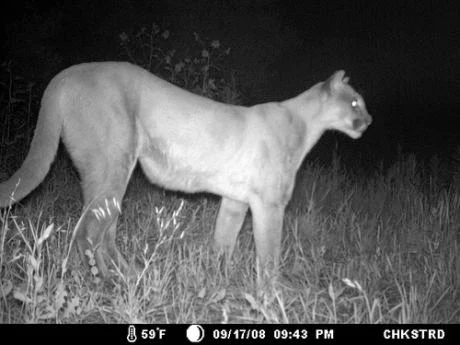
Should the Mountain Lion Distribution Map Be Redrawn?

I am just flagging up the thought that it may be wise to redraw the existing distribution map of the mountain lion.  The classic map which sets out the areas where the mountain lion is found in North, Central and South America including Mexico may need to be redrawn and in this instance I am writing about the United States of America.

Camera trap photo of mountain lion

The reason why I am suggesting this is because I am consistently receiving on my website reports of mountain lions in the states of North Carolina, Tennessee, Kentucky and Louisiana (Louisiana is near the edge of the existing range but not in it). Of these four, the North Carolina sightings are more frequent and this state is the farthest east of the four.

I do not believe that these are escaped pets but of course they might be.  Alternatively they may simply be genuine wild mountain lions which have migrated from the West to extend the distribution of this wild cat species in North America.

The classic distribution in North America tells us that the mountain lion is only found in the western half of America and Canada.  The division between West and East is not a straight line but it is a clear division nonetheless indicating that there are no mountain lions in the eastern half of America. This appears to be incorrect.

There is a pocket, an island range, of the mountain lion in Florida as we know. This is the Florida panther. I wonder whether the map should be redrawn to include some pockets of "island ranges" in the states referred to above?

Sunday, April 22, 2012

Jaguarundi Sounds (Vocalizations)

The vocal repertoire of the jaguarundi is "totally different from other felines". Perhaps this is not surprising as the jaguarundi looks different to all other felines! It looks like a marten or weasel or similar non-feline creature. The jaguarundi is a bit of an anomaly and classifying the species has been difficult.

Jaguarundi - Photo Dave Irving.

Balazs Buzas and Eszter Gulyas working at the Rare Species Conservation Centre in Sandwich, Kent, England, have raised jaguarundi cubs and in doing so have observed at first hand their vocalisations. They confirm the sounds made by this interesting wild cat as recorded by Cutter (1957) and Hulley in 1976.


There are 13  different sounds apparently:
  1. Short whistle: used for attention seeking. The response is a single "peep".
  2. Long whistle: a greeting.
  3. Chirp: calling when the other cannot be seen.
  4. Short purr: female calling kittens. Calling each other.
  5. Long purr: expression of contentment as for the domestic cat.
  6. Single quiet hiss: greeting from aged four weeks.
  7. Loud hiss: from the age of 2 days kittens and cats use this as a warning to stay away.
  8. Spit: warning to keep away. Insistent. A spit is on the video above.
  9. Scream/growl: sound made during fighting and when feeding and a challenge (scream) when mating. Listen to video but turn the sound down!
  10. Snuffle: vocalization made when patrolling territory.
  11. Chatter: made by smacking their lips together and a close greeting sound.
  12. Muted "yap": communication between individual cats under slight stress.
  13. Faint cry: made by female when sexually receptive.
Associated: Cat Sounds MP3 WMA WAV

Reference: All references to Hand-raising jaguarundis (puma yagouaroundi) by Balazs Buzas and Eszter Gulyas in Feline Conservation Federation magazine vol 56 issue 2 March/April 2012.


Tuesday, April 3, 2012

Cougar In Water

This is a really nice photograph of a Cougar in water in Brazil, South America by William Quatman. It is published on Flickr as well as here.

Photo: Copyright William Quatman.

The water is quite static it seems to me. Cougars (pumas) live in a wide range of habitats including seasonally flooded savannas. In Florida the puma is found in cypress swamps and well as other habitats (see range).

In the central-western parts of Brazil's Pantanal pumas usually use the drier habitats rather then the wetter habitats used by the jaguar.

Pumas are terrestrial but can swim and climb trees when needed. See Puma Cat for lots more and Mountain Lion Description.

Associated: Cats that like water.

Monday, February 20, 2012

Picture of a Puma in Brazil

Here is a beautiful puma (AKA cougar or mountain lion) in Brazil, specifically the Pantanal. It was taken in 2009 by photographer: Greg S. Garrett and is published on Flickr also.

Puma - Brazil - Photo by Greg S. Garrett

I find the photo very interesting. It has nice composition and a painterly quality. This is probably deliberate but Greg can explain why if he wants to in a comment!

The puma has the widest distribution of all the world's wildcats in the Western Hemisphere. The range extends in the north from well into Alaska.  In the south it extends to the southern areas of South America. The one wild cat with a larger range on the planet is the common leopard. These cats are very adaptable. The puma can live in jungle and more open areas.

The puma is probably in the top three of the world's best feline jumpers. They have great skill and power in that department. Their hind legs are unusually long providing extra leverage.

Personally I find it sad that people are still allowed to hunt this animal in the USA. No doubt the gun lobby and right wingers prevent any change to national or regional legislation.

See more about the Puma: Puma Range -- Puma Cat -- Wild Cats of the World Map.

Sunday, January 8, 2012

Andean Cat Pictures


These Andean cat pictures are by Jim Sanderson Ph.D. Almost all the Andean cat photographs on the internet are by Jim Sanderson and the ones that you see above are certainly well circulated! Jim kindly agreed to let me publish them here. He has, however, it appears, put them into the public domain but please ask him first (this is his website) or use the one on Wikipedia. I suspect that this is to promote conservation. With his colleagues in Chile, Peru and Argentina, he has done more than anyone else to highlight the conservation requirements of this small wildcat and carry them out. Jim Sanderson Ph.D. is a small wildcat specialist scientist.

The Andean cat is a rare wildcat that looks deceptively like a large domestic cat. There are an estimated 2,000 or so remaining in the wild - a precariously low population. I don't know if there are any in captivity. If there are it won't be many and they probably won't be doing well. In domestic cat terms the coat is a tabby coat. The heavily banded tail is one of the most striking physical features. It is quite long indicating a need to maintain balance on rocky surfaces. This cat lives in a rather harsh (by our standards) and barren landscape that is cold, in the Andes Mountains. Its main prey is the mountain vizcacha. It is sympatric with the Pampas cat. Read more about where this cat is and how it lives.

Thursday, January 5, 2012

Picture of Scottish Wildcat Leaping


This is another rare Scottish wildcat photograph by Rosie of Rosemarie Lamb Photography. We don't see many pictures of this small wildcat in mid air leaping after prey. It is published here with her permission. If you want to use it please ask the lady. The ticked coat and mackerel stripes are visible in the photo. The tail is heavily banded with a solid black tip. The Scottish wildcat is known for its ferocity when required - for example in defending cubs. Although this cat looks like a domestic cat it is usually about 50% larger and more muscular. The similarity between this wildcat and the domestic cat arises because the domestic cat was originally a domesticated African wildcat (Near Eastern wildcat). The outstanding problem with the cat in the picture is this: is it a purebred Scottish wildcat? It might be a domestic cat/wildcat hybrid because they interbreed. For me, the cat in the picture has a hint of hybrid about it but what do I know? This cat is in captivity. In general wildcats don't do well in captivity.

Wednesday, January 4, 2012

Picture of Scottish Wildcat Catching Prey


A very active and dynamic picture of a Scottish wildcat catching prey by Rosie of Rosemarie Lamb Photography. The photo is protected by copyright - ask if you want to use it, please. The cat is in an enclosure but this is still an excellent photograph. You won't see a Scottish wildcat photograph like this very often if ever. You can see the brown/grey tabby coat of this rare wildcat (400 left). And you can see those deadly claws, a part of large paws. The cat's body is twisted. The left hind leg is pointing to the rear. The expression on the face is priceless.  The Scottish wildcat is similar to a domestic tabby cat only a little bigger, heavier and well..wilder! It is said to be very fierce when cornered. This wildcat mates with domestic cats producing hybrids, which dilute the purebred stock of this wild cat. This is the greatest threat to its survival in the wild. Read more about sightings...See Rosie's original photo on Flickr (I made some small adjustments).

Tuesday, January 3, 2012

Pallas's Cat Picture

Manul or Pallas's cat - photo copyright all rights reserved: Rosemarie Lamb Photography

This is a Pallas's cat picture with impact by Rosemarie Lamb Photography published here with her permission. It is copyright protected. If you would like to use it please ask her. You can see the original on Flickr if you want to. Pallas's cat is a small wildcat that steps out of line in terms of appearance. The other, and perhaps more proper, name for this cat is "manul". This is a cute looking cat that reminds me of the domestic Persian in a very roundabout way. The very long fur and small ears with a rounded head are similar, which brings me nicely to a 19th century idea that the domestic cat was mated with the manul to produce the long haired Persian. That now looks far fetched and is wrong. All domestic cats originate in the Near Eastern wildcat which is short haired and relatively lanky so how did we arrive at the stocky, rounded Persian? Well, the original long haired cats may have come from Persia but the modern Persian cat has no genetic connection with cats from that part of the world. Things have moved on and the Persian domestic cat is wholly created in the West. The manul is the same size as an average domestic cat at about 6-10 lbs (manul description). It lives in the area north of India up through Mongolia to Russia. A chilly climate, hence the long coat. It feeds on small mammals such as pickas (a mouse hare) and gerbils.

Tuesday, December 27, 2011

Savannah Cat Picture


An active, dynamic Savannah cat picture by Helmi Flick. She is very good at capturing movement and shape on digital camera. A photograph of a Savannah cat should be dynamic because this is a large, active cat. When I say large I am referring to the F1s and F2s which can weigh up to 30 lbs. This is because the wildcat parent is a serval, which is a medium sized cat, the size of a large dog. The serval is quite intimidating. The Savannah cat, however, is a very beautifully socialized domestic cat no matter whether the cat is a first or fifth filial - proper socialization is emphasized. The F1-F2 Savannah cat is the cat of kings, the rich and the super rich. These are the world's most impressive domestic cats. The number one breeder is A1 Savannahs in the USA.

The guiding objective in respect of appearance is the wild cat parent, the serval, which has a clean, high contrast, spotted coat on a rustic, functional, buff-yellow background. The tail is not long and the cat is elegant in conformation. This is a long legged athletic domestic cat. The body conformation is really about function, which I think is sensible as it makes this breed a true cat rather than a fluffy accessory. You should have proper expectations of cat management if you intend to adopt an F1 or F2. The first three places in respect of the world's biggest domestic cats go to Savannah cats: Trouble (F1), Magic (F1- former world champion) and Motzie (F2). The serval has large ears for homing in on small prey in long grass. The Savannah also has large ears. Read and see lots more on this majestic cat breed....

Monday, December 26, 2011

Safari Cat Picture

A rare Safari Cat picture by Helmi Flick. This is wildcat hybrid that you will not see very often. I doubt whether they are shown at cat shows. Perhaps they make the odd appearance. The Safari Cat is not registered with TICA and they are perhaps the most adventurous cat association. That is not to say that this cat breed is unpopular. As you can see this cat has a stunning appearance. The Safari Cat is the result of a mating between the small wildcat Geoffroy's cat and a domestic cat. Sometimes the selected domestic cat is the Bengal cat (itself a wildcat hybrid). The Geoffroy's cat is sometimes (but rarely) domesticated itself. Clearly Geoffroy's cat is one of the small wildcats that can be domesticated. Incidentally the leopard cat - the wild component of the Bengal cat - can't! The picture above is an F1, first filial, Safari Cat. The coat is pure, dense, spotted tabby. The background color is a warm gray. The eyes are piercing and the face very strong. This is a large domestic cat at up to 25lbs (F1). You'll need to make special arrangements and have realistic and informed expectations. Read and see more....

Thursday, December 8, 2011

Bengal Cat Picture


A dynamic Bengal cat picture by the celebrated professional cat photographer Helmi Flick. This photograph is excellent because it is dynamic and has movement, which is an attribute of this breed. You can see a bit of the wild cat (leopard cat) in the face and posture. These are the characteristics of the Bengal cat provided (s)he has domestic cat qualities. The idea behind the Bengal cat was to create a bit of wildcat and to have that in the living room. Obviously the wild appearance and active behavior needs to be combined with a loving and dependable domestic cat companion. The Bengal cat is a bit special in that way. It is a cat breed apart from nearly all the rest and the first widely recognized wildcat hybrid domestic cat.

The photo on this page is protected by copyright ©. Violations of copyright are reported to Google.com (DMCA). I am sorry to be tough but people violate copyright and I have to protect Helmi's copyright as it affects her living.

Chinese Desert Cat Picture

Chinese desert cat - photographer unknown but presumed to be Jim Sanderson Ph.D.

This is a nice clear, clean Chinese desert cat picture. The cat is in captivity unfortunately. There is a second cat in the image. This is a rare and relatively little known subspecies of the wildcat. As you can see it looks similar to the domestic cat (but is twice the size), which is how it should be because the wildcat is the ancestor of today's domestic cat. This cat is found in China and Mongolia including the Tibetan Plateau. It lives at high elevations and in a rocky, semi-desert, mountainous landscape. It feeds on rodents. The primary prey is the little rock rabbit (pika) which unfortunately is poisoned by local people. This results in a shortage of prey for the Chinese desert cat. This together with being hunted for its fur means that it is assessed as Vulnerable by the IUCN Red List™ and it has a diminishing population size. The assessment of "vulnerable" refers to its status in wild regarding survivability. The Chinese desert cat is a subspecies of the wildcat. Its scientific name is: Felis silvestris bieti. Read and see more.

Saturday, December 3, 2011

Using Wild Cat Names

I am annoyed at the use of wildcat names because we use them a lot and we abuse the cats a lot. There is a kind of symmetry in our attitude towards wildcats but it is an unhealthy symmetry.

Examples are:
  • Puma (shoes)
  • Jaguar (cars)
  • Tiger (airline)
  • Tiger (Woods)
  • Bobcat (industrial machinery)
  • Wildcat (numerous sports teams)
  • Lion (software - Apple)
  • Snow leopard (Apple software)
There are countless more examples. Today (3rd December 2011), if you Google search using Google.com for "leopard" at the top is Apple software! Second is Wikipedia on the cat. Point made.

If you search for any mainstream wildcat you will find products and cats. If you use Google.com to search the news for "wildcat" you can forget about news on the cats! All you get is American sports team news.

Naming products after cats is fine as it shows that we admire the qualities of these magnificent animals. We should treat them well in the wild. We owe that to them.

We are gradually destroying the wild cat species in the wild. We are users.

Tuesday, November 22, 2011

Wild Cats of Southeast Asia

A list of wild cats whose range is in Southeast Asia. The wild cats are: tiger, leopard, Asiatic golden cat, fishing cat, jungle cat, bay cat, leopard cat, marbled cat, flat-headed cat, in descending order of size and weight. The spreadsheet below also shows a range map and there are links to more information about the individual cat species. Please go to the wild cat species page for more on wildcats.

Selected associated pages:

Saturday, October 22, 2011

What wild cats are in Australia?

There are no wild cat species in Australia. Surprising isn't it? There are ten wild cat species in nearby Southeast Asia.


There are many feral cats in Australia. The Australian authorities don't like feral cats, which could qualify as wildcats. The local governments think that the feral cat damages native species. They are allowed to shoot them in some states.


Thursday, July 30, 2009

Analysis of the Big Cat Video UK

It has been claimed to be "one of the best pieces of footage of a big cat in the UK". This is my brief analysis of the big cat video UK.


First it has to said that this is simply not a big cat. If it is a wild cat it would be classed as one of the small wild cats (see Wild Cat Species). It is about 2 feet long (excluding the tail) and looks like it weighs about 20+ pounds. This is gauged by comparison with the tracks (apparently 4 feet 8.5 inches wide in Britain). This cat walks like a small cat or domestic cat meaning lightly and without that slightly arrogant and slower paced walk of the bigger cats. Its shape is neither cobby (stocky) nor slender. The smaller big cats like the puma and leopard are quite slender with long limbs. This cat cannot be either. It cannot be a lynx because there is no ruff.

This cat has been described as "fearsome" and a "panther" by the tabloid press. Well it is not fearsome it seems to me. And it is not a panther as this is a term to describe melanistic (black) leopards and pumas. The smallest leopard weighs about 20 kg (44 lbs pounds - small female Cap Province -- Wild Cats of the World) and are normally about 50 kg (110 lbs the size of female person). The puma is quite a large cat with some small cat characteristics and weights at the lower end about the same as a small women. Both are larger by a factor of about 4 or 5 than this cat.

Domestic cats can weigh on average about 8 lbs but some weigh over 20 lbs. The all domestic cat, the Maine Coon can and frequently does weigh over 20 lbs. But this cat is not a Maine Coon as the fur is short on this cat and the Maine Coon is longer bodied.

It is more likely to be a large (top end) domestic cat than a wildcat. And this cat is behaving like a domestic cat wandering down a railway line. This cat is not behaving secretively as a wild cat would. It is very hard indeed to see a Scottish wild cat. It takes a lot of tracking and patience.

One viewer of the video made the comment that it could be a domestic cat/Scottish wild cat hybrid (first generation). This could be the case. They are black apparently and although the Scottish wild cat is the approximate size of a domestic cat with hybrid vigor the offspring could be larger than the parents.

I think it is also worth mentioning that this cat is not very elusive, is it? It is calmly walking down a railway line in broad daylight when it could be hold up in a den and coming out at night as black panthers are meant to do. And why is this oh so fantastic video footage, some of the best ever pretty poor, frankly. Over all the tens of years we have been told about fearsome big cats in the UK the best evidence we have is this poor camera phone video of a 20 lb domestic cat!

Analysis of the Big Cat Video UK - conclusion: Can the papers please stop exaggerating as this is irresponsible and puts fear into some people who might react badly to the cat and try and kill it? Being at the very top end of the domestic cat range it is more likely to be a very large domestic cat or a Scottish wild cat first generation hybrid and it is certainly not a black panther.

More reading:

Tuesday, July 28, 2009

Our Relationship with Cats

There are many millions of people who tenderly love and care for the domestic cats with which they live. There are many millions who are concerned about the wildcats. But there are not enough. Today I was shocked by a submission to the main website (www.pictures-of-cats.org) by a person who said she (or he, not sure) loved cats but poisoned them because her neighbours were irresponsible in letting them stray. And these stray cats upset her by defecating and urinating around her home. She also said that they bring fleas and "other insects". What she was doing or what she said she was doing was quite possibly a felony in her state of New York.

The person was arrogant and ignorant enough to state her views and actions on the internet on a site that gets a lot of hits. Beware doing such things as it can backfire. It does show us the level of "out of reality" lives some people live. The person's arguments were totally lacking in sound thought. And upon this ignorance, cats were, on the face of it, being cruelly killed - quite mindless and idiotic but an example of behaviour not that uncommonly seen.

I know that for many people who are not that fond of cats, feral or stray cats can be a nuisance. But the only way to deal with this is to deal with the owners. And as to the feral cats that can only mean being dealt with by trap, neuter return and plenty of investment in time and effort. There is no other way. Our relationship with cats can be quite fraught. And our relationship with cats is certainly very polarised. What I mean is that people have very widely held views, which makes a coordinated approach impossible.

Take feral cats again. There is the beginnings of a new direction in how to deal with feral cats at the governmental level in the potential city ordinance (laws) of Beverly Hills, Los Angeles. Beverly Hills could be the beginning of change and a proper approach to dealing with feral cats. Millions are killed each year. Some go into cat food - yes it's true. And one comment on a YouTube video about how some feral cats or unwanted domestic cats were turned into cat food, said that is was a good idea. Maybe you do too. But it cannot be right. It is not the way things were meant to have turned out when the wild cat was first domesticated. We thought that our relationship with cats would be beneficial to both cat and human. Now that "dream" has turned sour.

If feral cats are generally badly treated (and they are only surviving like you and me) then the domestic cat can have it pretty hard too. People in the USA have created a country where the domestic cat has to be kept in permanently. How odd and unnatural is that? And an unlikely and horrendous spin off from that (and I believe a contributory factor) is that 20% or about 20 million domestic cats in the USA are declawed. This is a crime in many European countries. America is a decent and good country with good and decent people, so what happened on this one? Something went badly wrong and I say it is largely to do with commerce and the veterinarians who encourage non-therapeutic declawing, a truly unethical process of great cruelty.

That said many people in the USA will say that declawing is OK and that they love cats. I just think that they don't understand and that misunderstanding comes from the people who do understand but hide behind euphemisms and denial, the veterinarians.

Our relationship with cats works brilliantly when we love our cat and let our cat be his or herself. When we accept out cat as he or she is. Is that so hard? If we can't do that it's OK. Just don't keep a cat. Is that so hard? If we wan companionship from a cat we should respect the cat. Declawing is highly disrespectful and much worse. See AVMA policy on declawing cats.

As to the wildcats, for me it is more sadness. Once again a different form of business is destroying the cat, businesses like the timber business destroying forest and the habitat of forest dwelling cats (African golden cat, Sumatran tiger and Clouded leopard to name three - there are many more). If it is not timber it is farming or some other business. Sure we have a right to make a living but it is time we did it in a way that doesn't destroy the planet. Is that so hard?

Wednesday, November 21, 2007

Iowa Ban Wild/Domestic Hybrid cats

AN ACT REGULATING DANGEROUS WILD ANIMALS, INCLUDING THEIR OWNERSHIP AND POSSESSION, REQUIRING REGISTRATION, PROVIDING FOR FEES AND APPROPRIATIONS, AND PROVIDING PENALTIES.

BE IT ENACTED BY THE GENERAL ASSEMBLY OF THE STATE OF IOWA

You can see an extract of this law under another article on the subject just below this one.

The photograph illustrating this article is by Helmi Flick copyright Helmi Flick

Comment: On the face of it this means a ban on Bengals including SBT Bengals (Stud Book Tradition). SBT Bengals are 4th generation, at least, and have about 12% wild blood in them. They are bred to be non-challenging and are true domestic cats, albeit it more active and more demanding than some other breeds.

This legislation which as far as I am aware is in force seems to have gone too far. Breeders have spent years developing a domesticated socialized Bengal cat. The other cats that fall into this category would be the Chausie and Savannah.

The tame wild cat would the Serval. Keepers can keep their "dangerous" cats (obviously) but need to register and pay a fee. As I understand it existing keepers will need also to microchip, supply a color photo of the cat, get insurance and keep the cat in an enclosure except under specific and authorized conditions.

Breeders can it seems seek exemption under conditions.

USDA licensed owners and breeders ARE NOT EXEMPT unless they are 501(c)3
non-profit as well, or are carrying out wildlife rehabilitation

I don't know what this means, if anything, on wider scale. Will there be a knock on effect and why are Bengals banned? What is the underlying thinking? On the face of it the purpose of the Act is the protections of the public from "dangerous" animals.

Are Bengal cats dangerous - No.

From Iowa Ban Wild/Domestic Hybrid cats to Cat Chit Chat

Search This Blog